Tuesday, November 28, 2006

Freedom from what?

In response to my last blog, someone asked the question: free from what?

It would require a long answer to fully explain it, but I’ll try to make a couple of comments. If you have further questions feel free to ask.

I would guess the main freedom is this: I grew up with the idea that the Gospel was primarily about going to heaven when I/we die. The focus was on making sure that I had the right/enough faith so that I could answer the famous Kennedy question: are you sure God would let you into His heaven if you were to die tonight?

This has also been a primary theme of my almost 30 years as missionary, evangelist and pastor. Can the other person also answer this question with confidence?

Underlying the concern for this question is of course the issue of hell. If someone cannot answer this question (and its companion question: on what basis should God let you into His heaven?) then I need to be concerned that he or she will spend eternity in hell.

This perspective led to several kinds of stresses: concern for the “lost” world and the pressure to take every opportunity to “lead someone to Christ”. No contact, friendship or relationship was without that underlying “pressure”. No sacrifice, even of family relationships, was too small for that one “eternal soul”. The “Day of Christ’s Appearing” was, in theory, a day of great joy, but in reality a day of judgement for myself (had I correctly believed?) and for those of whose “salvation” I was not “sure” whatever that meant, and that question was a source of many fiery theological discussions. Not to mention the “depression” of living in a world that was doomed to destruction, even though we did our best to obey the command to make the most of this world.

For the last 20+ years I have been wondering if that (eternal destiny) is the central issue of the Bible/New Testament. I have come to believe it is not. I’m not saying those issues are not discussed, they are just not the central ones.

N.T. Wright has helped tremendously in putting all these questions in a good Biblical context, one that takes the Bible and the work of Christ seriously. He asks (and provides (his) answers to) questions about what Jesus and the early church meant when they said certain things. It is a scholarly approach to the Scriptures that takes belief seriously, instead of the critical approach which undermines so much.

The perspective of the Kingdom as Wright outlines it really does “free” one from the stresses I mentioned above while providing a real positive way in which to be involved in today’s world.

The words of Jesus “as the Father has sent me, so send I you”, have taken on a much newer and deeper meaning for me, and I am able to put this into practice (with all my failures) with conviction and joy.

To understand more of Wright’s thought, see him Home Page, linked in that blog. I don’t have time or space here to summarize everything. Try his stuff on the resurrection first. The Resurrection as a Historical Problem, for example.

Monday, November 27, 2006

N.T. Wright, New Perspective, Emerging

The last few days I've heard a few lectures and discussions with N.T. Wright, read a few blogs about Emerging and that kind of stuff.


It is not all equally clear or helpful, but these movements, especially Wright, are putting some perspectives on the gospel and the church in the world that are just magnificent and so helpful and freeing.


If you don't know N.T. Wright, read some stuff from his Home Page.


I would say that this stuff doesn't really repudiate anything I learned growing up or what I got out of college and seminary. It does say that some things should be understood differently, but it is not negative in saying it is worthless or harmful.


It rather adds perspective and provides a way to ask the "critical" questions about the Bible without denying its authority or the centrality and necessity of Christ and His work.


I am much more able to put my whole heart, mind and life into the work of the church than I was before.


It is really too bad that so many Christians (and Christian bloggers) are so negative and unwilling to learn from these men. I understand why that is, but it is really too bad.


Don't be afraid to ask the hard questions. God will not "get you" if you do.


But keep Christ and His Word central.


powered by performancing firefox

Saturday, November 25, 2006

Test

This is a test of a new way to make entries to my blogs.

A program downloaded from Fire Fox.


See how it works.


Thursday, November 23, 2006

Pachelbel

This guy reminds me of my nephew Lee.

Not bad, and, as far as I can tell, authentic.

Dutch Elections Update

In the first place, more than 80% of the Dutch population voted. Compared to the USA a very high number. One reason for that is that people really feel they can vote for someone who represents their views.

Let me try to explain what happened.

The Christian Democratic Appeal has been the ruling party for the last 4 years. This party has its roots in Christian movements at the end of the 19th century. In order to form a majority, and thus a government, the CDA formed a coalition with the VVD and D66. Bascially conservative, moderate right wing, if you take everything together. Because the D66 pulled out of the Cabinet last spring new elections were needed.

The Labor Party was the great rival of the CDA and had hoped to win this election. Their leader would then become Prime Minister. Last spring it looked like they would win in a landslide.

The problem in Dutch politics is that there are really no "hot issues" at this moment. The immigration issues are pretty much resolved, the economy is getting better, government finances and the welfare system have been reformed. More work needs to be done, but essentially things are going along OK.

Interestingly enough, the Iraq War was not an issue in these elections. And the environment did not get much attention either.

So what happened? The CDA lost some seats but is still the biggest party and will probably provide the Prime Minister (Balkenende again). The VVD and D66 lost big time. They are totally out of the picture.

The Labour Party lost also. They do not have enough seats to come close to forming a coalition government.

The winners?

The SP, the Socialist Party, went from nine to twentysix seats. These were the old communists. They took many voters from the Labor Party. Primarily because of the trustworthiness of the leader of the SP. People trusted him more than the young leader of the Labor Party, Wouter Bos.

Two big surprises:
The Party for Freedom won nine seats. This party is very right wing, extremely so.
And the Party for Animals won two seats. A party that wants to protect the rights of animals. For example, this party wants to ban the castration of pigs without anaesthesia.

So the Dutch politcal landscape is splintered. That will make forming a government difficult.

The Christian Union, a conservative evangelical Christian party, had 3 seats in Parliament, now has 6 seats.

There is a chance that this party is big enough that it could form, with other parties, a majority in Parliament and thus help form the government.

Imagine: in liberal, apostate Holland, villified because of its policies on drugs, sex, euthanasia and homosexuality, an evangelical conservative Christian party may play a major role in the government.

I wonder what World Magazine will say about that, if anything.

Wednesday, November 22, 2006

Dutch Elections

Today the Dutch vote for a new Parliament and Cabinet.

I must say I really like the parliamentary system. Actually, the Dutch system is offically called Proportional Representation. See Wikipedia for the differences.

There are quite a variety of political parties, so you have a good chance that you can get people in the parliament who reflect your own views, even if that is only one person.

It also forces parties to work together. If no party gets a majority of seats in the Parliament (and that almost never happens), then parties need to work together to form a majority and construct the Cabinet.

Even for Christians in Holland there are a couple of good choices to make, in which you can think about moral, economic, political and environmental issues.

I will never forget that a relative once asked me, "Well Norm, what's it like living in a communist country?"

Holland gets a lot of bad press in the U.S.A. of the Religious Right. Most of it, like this question, rooted in ignorance and fear.

Don't get me wrong - there are a number of things about Holland that drive me absolutely crazy.

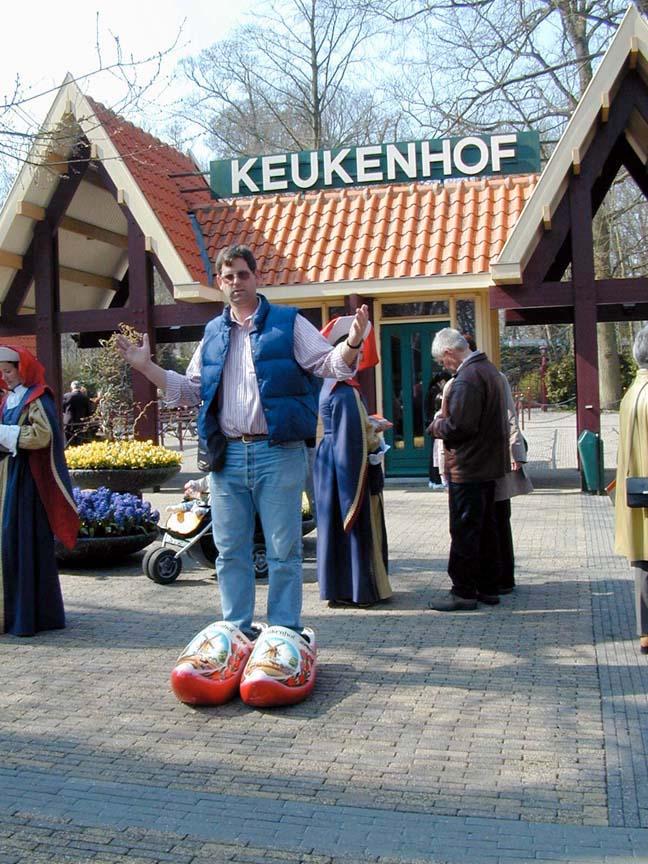
But the windmills, tulips and wooden shoes are really cute.

Tuesday, November 21, 2006

Friday, November 17, 2006

Unpopular anywhere

"Political experts say President Bush planned a trip to several foreign countries this week because he is unpopular at home. In response, the White House said, That's ridiculous. The president is just as unpopular overseas."
--Conan O'Brien

Tuesday, November 14, 2006

Bush Sr.

Seems George W. Jr. has been to the woodpile with his father.

George Sr. thinks George Jr. is making a mess of things.
He wants to make sure his son doesn't get a bad name in the history books.

He has told his son to go to his room and be quiet.
He has sent two of his old helpers to the White House to straighten things out.

James Baker, Secretary of State for president George H.W. Bush, now heads the Iraq Study Group and paid a visit to the White House yesterday.
Robert Gates, Director of the CIA for president George H.W. Bush, will take over for Rumsfeld at the Department of Defense.

Not a bad deal.
Something profitable gets done in the Middle East.
George Jr. gets the credit.

I don't really care if George Jr. gets the credit or not, as long as this disaster he has gotten us into gets turned around.

Friday, November 10, 2006

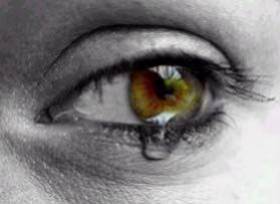
God's tears

I ran across this quote from someone on a blog this morning.
I thought it was good food for thought for today.

Without Jesus, God doesn't have tears.

Thursday, November 09, 2006

Rumsfeld 2


In brief remarks yesterday, Rumsfeld described the Iraq conflict as a "little understood, unfamiliar war" that is "complex for people to comprehend."

So we are dumb? Is that the problem?


Check these quotes out from our former Defense Secretary:

"I would not say that the future is necessarily less predictable than the past. I think the past was not predictable when it started."

"I am not going to give you a number for it because it's not my business to do intelligent work."

"I don't know what I said, but I know what I think, and, well, I assume it's what I said."

"There's another way to phrase that and that is that the absence of evidence is not the evidence of absence. It is basically saying the same thing in a different way. Simply because you do not have evidence that something does exist does not mean that you have evidence that it doesn't exist."

"If I know the answer I'll tell you the answer, and if I don't, I'll just respond, cleverly."

C.S. Lewis once said, "you don't make nonsense sense by putting 'God can' in front of it".

You don't make nonsense sense by having Rumsfeld say it and then calling us dumb when we don't understand it.

Good riddance.

Wednesday, November 08, 2006

Rumsfeld

Maybe Bush is starting to get the idea.

I haven't seen his news conference yet, but I hope he is starting to realize that "stay the course" isn't always the most productive course to stay on.

A good step is that Rumsfeld is gone. The arrogance of that man was always appalling to me, as was his inability to really understand how the world works. (Or maybe he does understand how the world really works, but that would be so appalling to many of us if we heard it that he makes sure we can't find out.)

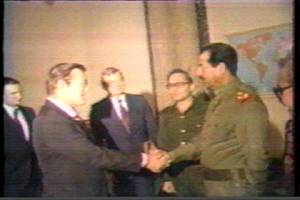
It's pretty hard to forget Rumsfeld's handshake with Saddam Hussein in 1983.

I hope the Bush administration will work with the new Congress and Senate to bring some sanity back to this "War on Terror".

I will be terrified if he doesn't.

Friday, November 03, 2006

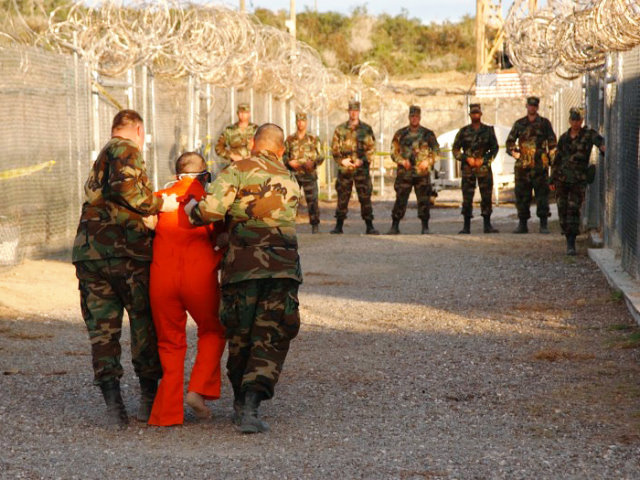
Back to Abu Ghraib

This man (second from left in this photo) is heading back to Iraq.

He doesn't really expect to survive his stint there.

He will pose a danger to any troops with whom he works.

His job? To train Iraqi police.


Did you know Muslims consider dogs to be "unclean"?

Thursday, November 02, 2006

Overindulgence

Fortune Magazine reports:

Sales of big pickup trucks and SUVs went through the roof - doubling from the year before in some cases. Sales of small, fuel efficient cars, meanwhile, remained stagnant. It is as if all that moaning and groaning about price gouging by oil companies never happened....

As Americans flock back to their old buying habits, it is all too easy (for sociologists) to lump excessive fuel consumption in with other bad habits involving overindulgence: over eating, over spending and over television watching....

The supply of oil is not limitless but apparently the current generation of Americans is all too willing to exhaust it by buying more vehicle than they need and letting their children and grandchildren fend for themselves.

So many conservative Christian bloggers are all up in arms about the Emerging Church or the New Perspective on Paul, wildly promoting Spurgeon, Owen, Augustine and Calvin in order to restore doctrinal purity to the church and America.

You never hear them on these kinds of issues.

Friday, October 27, 2006

Press Conference

In his Press Conference on Wednesday President Bush said the following:

Over the past three years I have often addressed the American people to explain developments in Iraq. Some of these developments were encouraging, such as the capture of Saddam Hussein, the elections in which 12 million Iraqis defied the terrorists and voted for a free future, and the demise of the brutal terrorist Zarqawi. Other developments were not encouraging, such as the bombing of the U.N. Headquarters in Baghdad, the fact that we did not find stockpiles of weapons of mass destruction, and the continued loss of some of America's finest sons and daughters.

The fact that no WMDs were found, and that almost three thousand of "America's finest" have been lost he describes as "not encouraging".

One just doesn't know what to make of this. A remark like this, not written down but said in answer to a question, could be passed over as another grammatical gaffe of the President's. He makes so many of them.

But this was in his written, prepared remarks.

Imagine having lost a loved one, and the Commander in Chief calls it "not encouraging".

Tragedy would have been a much more appropriate word.

But then, things are getting less and less appropriate.

Wednesday, October 25, 2006

Monday, October 23, 2006

Watch who you call.....

Timing

WASHINGTON (AP) -- President Bush, who gets higher marks for handling the economy than running the Iraq war, is spending two days this week trying to convince voters Republicans are the best stewards of matters affecting the wallet.

White House advisers said Sunday that Bush is not trying to change the subject from a deteriorating situation in Iraq, and that he will continue to talk about Iraq and the war on terrorism as the November 7 election nears. Bush advisers said they think the president should get more credit for recent positive economic news.....

The AP-Ipsos poll this month found that 37 percent of likely voters say they approve of Bush's handling of Iraq overall.

Forty-two percent approve of his handling of the economy.


I think I'd change the subject too.

Thursday, October 19, 2006

Traumatic Brain Injury

This video is circulating on the web.
Promoting it is the Iraq and Afghanistan Veterans of America.
They're upset because Congress is considering cutting funding for reasearch into understanding and treating Traumatic Brain Injury caused by explosives detonating close to a soldier.

Imagine that you were here.
You understand why they are singing and doing everything they can to reduce tension.

It is such a shame and waste that our leadership has sent them there.

Wednesday, October 18, 2006

Epitaphs

Here lies Ann Mann,
Who lived an old maid
But died an old Mann.
Dec. 8, 1767

Sir John Strange
Here lies an honest la
wyer,
And that is Strange.

Here lies Lester Moore
Four slugs from a .44
No Les No More.

She always said her feet were killing her
but nobody believed her.

Under the sod and under the trees
Lies the body of Jonathan Pease.
He is not here, th
ere's only the pod:
Pease shelled out and went to God.

Here lies an Atheist
All dressed up
And no place to go.

Here lies my wife: here let her lie!
Now she's at rest, and so am I.

Tuesday, October 17, 2006

Poker Bush

Our president is a real poker player.
If you had to choose who to have on your team while dealing with those crafty opponents in international politics, you would choose him "hands down".

This direct quote from his press conference last week in the Rose Garden:

"One has a stronger hand when there is someone playing your same cards."


Monday, October 16, 2006

North Korea

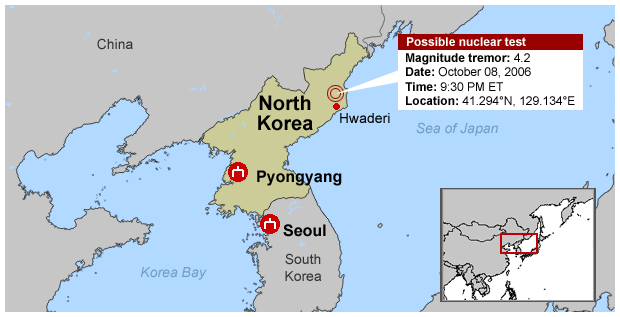
"Earlier today at a press conference, President Bush said he will not attack North Korea. Well, of course not. They actually have weapons of mass destruction."

--David Letterman

Friday, October 13, 2006

His job is his job

I can't resist this one either. If you want the heart of it, start at 4:30.

Micah 6:8

He has showed you, O man, what is good.
And what does the LORD require of you?
To act justly and to love mercy
and to walk humbly with your God.


Wednesday, October 11, 2006

What if the Amish were in charge of the War on Terror?

Finally, after months of reading all kinds of (Christian) blogs, one which actually promotes some real Christian ideas in the real world. Diana Butler Bass wrote this one. I know it sounds unrealistic, and that there is something of an apples/oranges relationship between the Amish and Al Qaeda, but this is an attempt to think truly Biblically and in a Christian wat about international matters.

I'll tell you, I think the Bush administration has gotten us into so much trouble in Iraq, Iran, Afghanistan, North Korea - we are in deep doodoo and I don't see much of a real Christian perspective anywhere around. Try this on for size - Biblical size:

I confess: Over the last 10 days, I did not pay much attention to the Amish school shooting. As the mother of an 8-year old girl, I find school violence stories too painful to follow.

Despite attempts to avoid this particular news, the stories of the Amish practice of forgiveness eventually captivated me. Their practice of forgiveness unfolded in four public acts over the course of a week. First, some elders visited Marie Roberts, the wife of the murderer, to offer forgiveness. Then, the families of the slain girls invited the widow to their own children’s funerals. Next, they requested that all relief monies intended for Amish families be shared with Roberts and her children. And, finally, in an astonishing act of reconciliation, more than 30 members of the Amish community attended the funeral of the killer.

As my husband and I talked about the spiritual power of these actions, I commented in an offhanded way, “It is an amazing witness to the peace tradition.” He looked at me and said passionately, “Witness? I don’t think so. This went well past witnessing. They weren’t witnessing to anything. They were actively making peace.”

He was right. Their actions not only witness that the Christian God is a God of forgiveness, but they actively created the conditions in which forgiveness could happen. In the most straightforward way, they embarked on imitating Christ: “Father, forgive them; they know not what they do.” In acting as Christ, they did not speculate on forgiveness. They forgave. And forgiveness is, as Christianity teaches, the prerequisite to peace. We forgive because God forgave us; in forgiving, we participate in God’s dream of reconciliation and shalom.

Then an odd thought occurred to me: What if the Amish were in charge of the war on terror? What if, on the evening of Sept. 12, 2001, we had gone to Osama bin Laden’s house (metaphorically, of course, since we didn’t know where he lived!) and offered him forgiveness? What if we had invited the families of the hijackers to the funerals of the victims of 9/11? What if a portion of The September 11th Fund had been dedicated to relieving poverty in a Muslim country? What if we dignified the burial of their dead by our respectful grief?

What if, instead of seeking vengeance, we had stood together in human pain, looking honestly at the shared sin and sadness we suffered? What if we had tried to make peace?

So, here’s my modest proposal. We’re five years too late for an Amish response to 9/11. But maybe we should ask them to take over the Department of Homeland Security. After all, actively practicing forgiveness and making peace are the only real alternatives to perpetual fear and a multi-generational global religious war.

I can’t imagine any other path to true security. And nobody else can figure out what to do to end this insane war. Why not try the Christian practice of forgiveness? If it worked in Lancaster, maybe it will work in Baghdad, too.

Tuesday, October 10, 2006

Voortrekker Monument

Last Friday we visited the Voortrekker Monument in Pretoria, built to honor the Afrikaanse pioneers who left the coastal areas and British subjection to forge their way into the frontiers of South Africa.

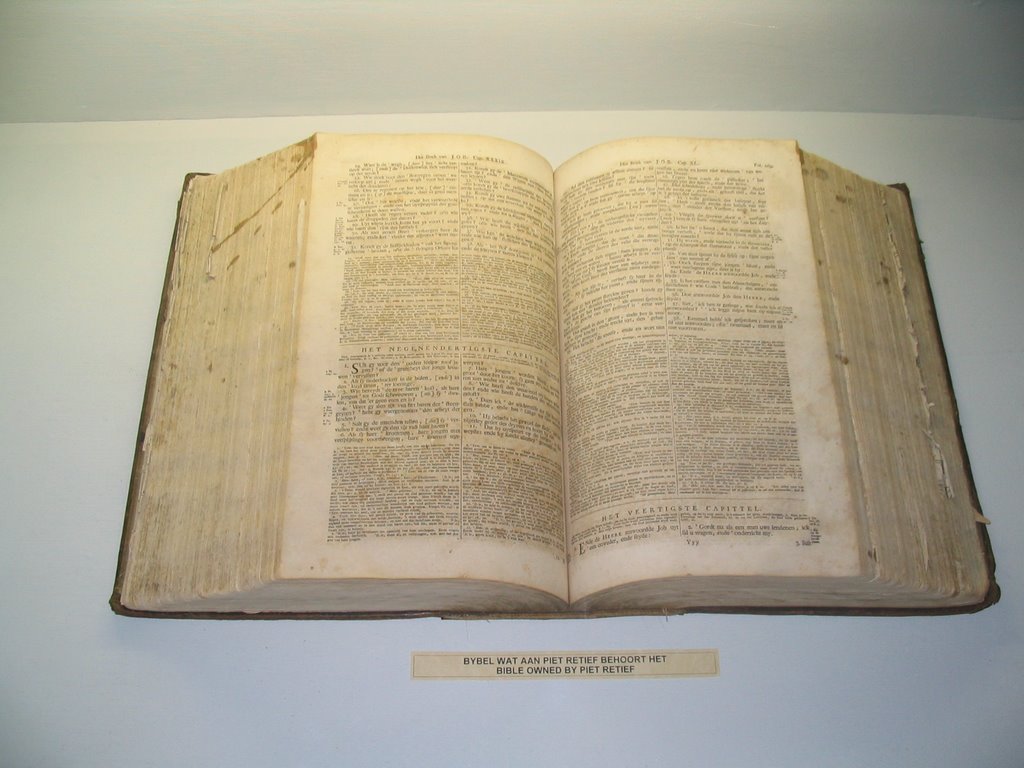
These migrations were partly theologically motivated. The Pioneers, Dutch Reformed Calvinists, read the Old Testament and saw their story in the story of Israel and her journey to the Promised Land. They believed they too were God's people, with rights to their own Promised Land. In the museum of the Monument you can find their Bibles and books of sermons, which were read in Sunday services when a minister could not be present.

The Battle of Blood River is steeped in theology, prayer en religious observance. Read about it here.

The day of this battle will never be forgotten. On December 16 every year, at noon, the sun shines through a tiny hole in the dome of the monument and lights op an inscription on a crypt placed far below on the lower level. The inscription reads: We for Thee, South Africa. The day used to be called The Day of the Vow, but since 1994, the first free elections in South Africa, the day is called The Day of Reconciliation.

I wonder if it is possible that we today read the Bible and find in it the justification for things we want to believe.

Why should we be any different than the Pioneers?

Flight

After all these years of flying I still am amazed at how these planes can cover such enormous distances exactly on time. I enjoyed our flight from Johannesburg tremendously. At around 7 AM the sun came up and we had wonderful views of the Sahara of North Africa, the Mediterranean, South Europe and the Alps.

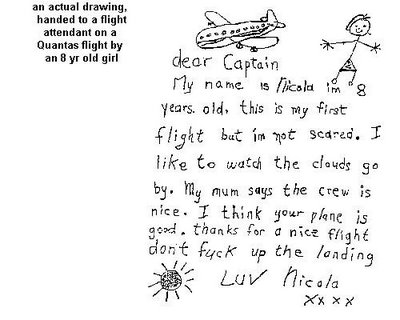
I ran across this little note yesterday. It struck my funny bone. Warning: If you don't want to read the f** word, don't read the note.


Monday, October 09, 2006

Strangers

Yesterday morning we arrived home from our vacation in South Africa. It was a wonderful vacation. We enjoyed being back in Africa. And it was really Africa - but Africa with an infrastructure.

High point was our contact with my sister and her husband. We have never really as adults spent much time together, but because we both have lived for a long time in “foreign” countries working for Christian organisations we have much in common. We were able to share our lives with and encourage each other.

I was reminded again of the fact that we live our lives very clearly now as “strangers” and “foreigners”. We have lived so differently from our family and the friends we grew up with that we have become strangers to them. They will never understand us completely. We will never be completely at home anywhere again – not where we came from, and not where we live now.

A friend of mine reminds me often that that is a painful spot for me. And he is right. I notice that, the longer I live here in Holland, the more pain I experience as I experience what it means to be a stranger.

But there is something very positive I can do with that feeling. I can recognize it as something that has been given to me. It is part of me and who I am.

If it is true that “power is made perfect in weakness” (2 Cor. 12:9) then this being a stranger with the pain it carries with it can be a source of strength for me – a strength that would not be there without it.

If I were to lose that pain, I would lose that strength. So I cling to the pain, not because it is fun, but because it has a goal – a country of our own. (Heb. 11:14).

We were privileged to be able to share that with family.

I will draw strength from that in the coming weeks.

It is very practical.

Wednesday, October 04, 2006

Assumptions

Recently I had a chat with someone who had been raised in an evangelical Christian environment and had been an active Christian until recently. A number of factors caused him to give Christianity up for atheism. The “conversion” was not a sudden one – it took place over a number of years. He was very honest to admit that it was harder to be an atheist than a Christian, mostly because it meant that he was totally alone in the world/universe to solve every problem and make every decision.

Two other things about the conversation struck me and confirmed (again) things I have been thinking for years.

The person told me that since he had become an atheist, all of his Christian friends except two had broken off their friendship with him. The reason was that their basic assumptions and beliefs about the world were not the same any more, so how could they remain friends?

There is a tendency on the part of Christians to build friendships with a purpose. That purpose is usually either evangelism or discipleship. If neither of those things can happen any more, the friendship really has no reason for existence.

Over the years I have found this a difficult part of Christianity to live with, and in fact, I have chosen to change my assumptions about life and Christianity so that I do not have to live with this tension any more. A fruit of that is that I enjoy real friendships with “non-Christians” in which we can share any aspect of our lives with each other, and have a meaningful impact on each other's lives.

When I suggest to Christians that most Christian friendships have an ulterior (manipulative, if you want to be negative) motive, it is strongly denied. This conversation confirmed my observation. And it really shouldn’t be that way, I don’t think.

The second thing had to do with motivation for evangelism. I am convinced that, when everything else is stripped away, the fear of hell is the fundamental motivation for Christian evangelism. You don’t have to read many conservative Christian weblogs to have that observation confirmed. See this link from Desiring God, for example.

Lately I’ve listened to some stuff put out by the Way of the Master Radio broadcasts. Hell is big with them. They have substituted the word hell with a much more precise theological term: a real bad place. But the meaning remains the same.

Again, most Christians deny this when you put it to them this way. But I don’t really believe them.

After we had talked about hell a little bit, and I tried to put it into another perspective, my conversation partner asked the classic question: “If hell isn’t the motivation, why do you evangelize then?”

See what I mean?

If you are a Christian, and one who wants to evangelize, I would encourage you to be honest about why you do it. If fear of hell is your motivation when all other things are stripped away, at least be man or woman enough to admit it. (And please don't misunderstand me - I'm not saying that this fear is the only motive. There are other very positive motivations also.)

And if you find that to be your primary motivation, perhaps you should ask yourself if that really is the biblical motivation for evangelism, or if there is not some way to change the paradigm so something besides fear drives you.

Tuesday, October 03, 2006

Birthday

Today I have turned 53. (Yes – all you faithful readers may feel free to congratulate me!)

This morning I thought about what I wrote at the beginning of “My Story” on my website:

My mother is very proud of me. She thinks I have the Midas touch.That is, I suspect, an attempt on her part to neutralize just about the first words spoken about me.I was just born. My parents stood in front of the window of the baby nursery, admiring their son (in those days – 1953 – newborn babies were placed alone in the baby nursery) . The grandparents of another baby stood at the same window.Admittedly, I was not big. But apparently there was something else about me other than my size that prompted one of the other grandparents to say – without considering who might be standing next to them – “isn’t that pathetic!”.I heard nothing of this. My parents were stunned at these words but my mother’s pride in me could not be shaken.

Fifty-three years later the end of that story still applies to me:

Should my mother be proud of me? I think it would only be honest to say “yes” in answer to that question. I am involved in profitable ways with people and both Cyndi and I are professionally and privately contributing to our society. We are still married and our children are healthy and well. Our life is stable, but not at all boring. Every day is different and we have the opportunity to travel and pursue our hobbies.

I am so thankful for Cyndi, my wife of more than 32 years, and all our children: Sarah and Aaron, Ben and Ramona, Will and Mariana. Not to mention our grandson Jeremiah. (There are hundreds if not thousands of other people I could mention also. I'm thankful for you too!)

The foundation for my life has been and continues to be God’s grace. Psalm 27 is my favorite Psalm and Bible passage.

The LORD is my light and my salvation— whom shall I fear?
The LORD is the stronghold of my life— of whom shall I be afraid?

I am still learning not to be afraid, and to swim in the endless sea of God’s grace. It is wonderful!

And through the difficulties of life – that I also experience – this verse keeps me on course:

I am still confident of this:
I will see the goodness of the LORD
in the land of the living.

I wish you all a very blessed day!
Don’t be afraid, and expect good things!


Monday, October 02, 2006

Memories

Yesterday we arrived safely back in Johannesburg after driving 4000 kilometers (2400 miles) in 10 days.

We chose another route for the return trip from Cape Town, a route that took us through the Little Karoo and the Great Karoo. An absolutely wonderful landscape it was - we enjoyed the birds, flowers and animals. We saw baboons, a monitor lizard, a kudu and a hoopoe bird.

Africa can change so quickly. At 11 AM on Saturday the temperature outside was 64 degrees. By 3 PM it was over 100 degrees.

Saturday night we slept in a B&B called Eenzaamheid, in the bush 12 miles from the road. We were warmly welcomed by the lady of the house, who had lived there for nine years with her husband and two children, aged 4 and 2. She cooked us a wonderful meal, which we enjoyed thoroughly.

Her husband is the fifth generation to live and run that land. Their name is Theron, and as we drove away we saw a tiny graveyard with the name Theron on all the gravestones.


It all reminded Cyndi and I very much of our first years in Nigeria. And the memories and stories began to flow, much faster than they ever do in Holland.

Thursday, September 28, 2006

Cape Town and Table Mountain

We are enjoying our time around Cape Town immensely.

Yesterday we climbed Table Mountain via the Platteklip Gorge.

It is a strenuous hike, as you can see from this website. We did it in 21/2 hours, which was pretty good, I guess.

It tok a lot out of me, but was a very beautiful trip.

For a lovely photo of the gorge, click here.

Monday, September 25, 2006

Community

Saw a wonderful live open air concert in Cape Town yesterday. The Moreira Project. The swing of black musicians with a mostly black audience brought tears to my eyes.

Before the band came on, a storyteller told a story. (Sermons should be that way). One thing he said struck me:

You are because I am.
I am because you are.

That is Africa, I thought. Community. I only exist because the other exists, and he/she can only live if/because I live.

We have lost that in our western society. People are "objects", "products". Means of exchange.

My partner is there to meet my needs.
The shopkeeper provides me a service.
I want to help my children grow up and be productive.
I support my friend and he/she me.
The politician tries to provide a peaceful and wealthy society.
The congregation pays its minister to deliver a reasonable sermon and be there in times of crisis.
The minister tries to keep his/her congregation on the straight and narrow and hopes to receive a word of encouragement in the process.

But the thought that I can only exist because the other is there? And he/she because I am there?

Paul said "do not be conformed to the thinking of this world".
It seems to be like we have conformed big time.

Try to look at other people differently today.

You cannot "be" without them. and they without you.

Wednesday, September 20, 2006

Apartheidmuseum

I was speechless.

A very well done museum - you can tell that by this sign.

There are no words for the type of evil committed during this period of South African history - which wasn't all that long ago.

There are no words for the type of heroism of those who gave everything for the cause they believed in.

Tuesday, September 19, 2006

Maher Arar

This is what I meant in my post "Can we trust him now"?

The story of Maher Arar.

Saturday, September 16, 2006

Vacation

Tomorrow my wife and I fly from Amsterdam to Johannesburg, South Africa.

A sister of mine lives there, and she works with her husband for Trans World Radio.

We're also going to the Cape to see the Southern White Whales and pay a visit to Cape Town and Table Mountain.

We're very excited to be able to go back to Africa again, and we're interested in the culture there and the influence of apartheid.

I won't be blogging so much for the next three weeks - vacation is, after all, vacation!

I will try to do some, but the frequency will be less.

Until the next time. Take care of yourselves.

Thursday, September 14, 2006

The surprise of washing feet

Jesus washed the feet of his disciples.

He was their Lord, Master and Creator, and he kneeled down before them and washed their dirty feet.

When he was done, he gave them a command: "Now that I, your Lord and Teacher, have washed your feet, you should also wash one another's feet."

His command contains a surprise. You would think that he would say, "I have served you, now I want you to serve me."

That's what is often preached in church. God has done X for you, now go and do Y for Him. (Even gratitude is placed in that light.)

But that is not what Jesus says.

I have done it for you - now go and do it for someone else. The movement is horizontal. Because Jesus has washed my feet, I go and look for someone else whose feet need washing.

It does, of course, come back to Jesus in the end. "Whatever you did for the least of these brothers of mine, you did it for me".

If you have lost contact with God, or don't know exactly what He wants you to do, maybe this will help.

Go look for a pair of dirty feet.

Wednesday, September 13, 2006

We're safe

Can't resist this one either.
Mostly the words of our President. Much more doesn't really need to be said.
Remember "does 'is' mean 'is' or doesn't it"?

Tuesday, September 12, 2006

Judge ye not one another

When I look back at our years of church planting in Amsterdam I am struck by a focus that lay close to the heart of our ministry: we felt we needed to know whether or not someone had crossed the line from death to life, from darkness to light.

The theology was that people are in darkness, heading for hell, sinking in the cold waters of death in the same way the victims of the Titanic were sinking so many years ago. It was a question of life and death to provide the way to escape from destruction, but also to know whether a person had made sufficient use of the means of salvation provided to him or her.

Someone would, on the street in Amsterdam, pray the “sinner’s prayer” and make a profession of faith. We would write home about that with great joy – someone had escaped from death into life!

But we were also realistic and we were trying to build a community of believers. So we would see that person be sporadic in church attendance, irregular in pursuing spiritual disciplines, and persistent in continuing a lifestyle that was not in accordance with Biblical norms.

The question would inevitably arise: Was the profession of faith credible? Had the person really passed from death to life?

And so we spent quite a bit of time trying to determine, for the community in general but also in specific instances, what the real indications were that someone had credibly crossed that line.

It was a perfectly logical and necessary thing to do, given our theology. It was a question of life and death.

But it made me uncomfortable:

Was not the motivation for our ministry primarily fear – fear of destruction and hell? And is that the Biblical motive for ministry?
How much of what we did was manipulative, based on fear? (And manipulation is perfectly legitimate when the situation is a matter of life and death. If I am rescuing someone from a burning building, then every possible means is valid.)
Did I really love the person as a person?
Was it right or good for me to make a determination about the person’s spiritual state? Was that my job, and was I capable of doing that?
It felt moralistic to me to judge a person’s heart based on his or her actions. I didn’t want to be a moralist. And wasn’t it a little bit weird to write joyfully home about someone’s conversion and be doubting it a few months later?
Even “friendship evangelism” could never completely convince me that the “friendship” was little more than a method to get to the real and important issues. I was struck by that especially when I finally did have a few “real” friends who were not Christians and whom I was not actively trying to “convert”.

Given the paradigms, what we did was the right and necessary thing.

But why did I feel so uncomfortable while doing it?

Monday, September 11, 2006

Turning Point

It was a defining moment for me theologically and personally.

We had a series of follow-up evenings after a summer of street preaching in Amsterdam (this was about 14 years ago.) The topic this evening was “Forgiveness”. I had, in several short presentations, made some comments about forgiveness and its roots in the Gospel and Jesus’ forgiveness of us.

At the end we opened things up for discussion and comment. A number of people said things about what they thought forgiveness was and how it impacted their lives.

One woman whom we had met on the street, in her early 30s, told the group that her father had abused her when she was a child. She had , in the last few years and with the help of a psychologist, been learning how to forgive him. She commented on how hard that was but how good it was for her to be taking those steps. It was moving.

Then a fellow team member of mine stood up and in gentle but clear terms informed that woman that her forgiving of her father was at best incomplete and at worst sinful if she was not doing it out of an active faith in Jesus. She had not repented and believed in Jesus as her Savior and Lord. Her forgiveness of her father was fatally flawed. My team-mate did not quite say “worthless”, but that was the bottom line.

My team-mate was responding completely in accordance with our (Reformed) evangelical Christianity. All our righteous acts are like filthy rags.

But something in me protested and my heart broke. Here was a woman, trying to recover from an abusive childhood, taking the only steps she knew how to take to turn horror into hope.

And the first thing we had in our suitcase to give her was the thought that these acts of hers were really filthy rags.

Was this the way Jesus would have responded? I tell you the truth, I have not found anyone in Israel with such great faith.

For the first time I realized that something about my theology had to change if I was going to be able to minister in Amsterdam and come out of it alive.

It was the beginning of a long journey.

Friday, September 08, 2006

Can we trust him now?

President Bush gave a speech this week in which he acknowledged the existence of secret prisons for terrorists. I happened to see most of the speech “live”. A couple of comments:

He continues to want to scare us. I don’t know how many times he used the phrase “they want to kill innocent Americans”. Apparently he thinks that the more afraid we are the more likely we are to support his policies.

It seems he has forgotten or doesn’t believe that the terrorists also want to “kill innocent Europeans”. We weren’t even mentioned. I guess we don’t count. (I have a double nationality: half of me is afraid, half of me doesn’t count.) When is he going to realize that the world is bigger than Crawford, Texas?

And he wanted to assure us that the CIA is doing great work: they are arresting terrorists, squeezing the information out of them, and using that information to save thousands of “innocent American lives”. And of course, we don't torture..........

I remember that he once told us with the same look in his eye and tone of voice that Iraq had weapons of mass destruction. We could trust the CIA and U.S. intelligence on that one, according to him.

We couldn’t then. How do we know we can now?

(Please don't misunderstand me. I'm not suggesting that Bush deliberately lied regarding Iraq. Born-again Christians don't deliberately lie ;-). But apparently the CIA, U.S. intelligence and the American government was not capable of providing us with trustworthy intellingence information. If they couldn't then, how do we know they can now?)

Thursday, September 07, 2006

The Church Blew it

One of the striking things about Dutch culture in comparison to American culture is the depth of the aversion to the church felt here. If you want to get someone really angry really quick, start talking about the church.

That’s understandable. In this small society of people the church has played a significant role through the years, and the splits have broken through family lines and cause pain even today.

An example: The Dutch Reformed Church (Liberated) was formed in 1944 as the result of a split caused by a somewhat obscure theological question which erupted into an argument over one word in the Church Order (Article 33, to be precise).

Notice the date: 1944. Think back to what was happening then. That’s right – World War II. Nazi occupation. Allied invasion. Hunger winter in Amsterdam in which people ate tulip bulbs to survive (I have people in my congregation who remember that).

And in the eastern, rural part of the country, where people had food - a church split.

The Liberated Church considered itself to be the only true church, with roots back to the Apostle Peter. In fact, when the story of God’s redeeming acts in history is taught in the schools of the church, the split of ’44 is found in the same list as Noah, the Exodus, and the return from exile of Israel. (I think there are plenty of people today who still believe that, although very few will now say it out loud.)

When we first came to Amsterdam, we were told that there was only one address for the true church in Amsterdam – and you’ve probably already guessed which one that was!

An American cannot believe the impact of church history for the society here. I will not say that there are no benefits to be found, but the overwhelming legacy is one of disillusionment, pain and anger. You would be hard pressed to find a society more plagued by depression and low self esteem than this one.

Can you understand why the language of “battle for truth” is not helpful here?
Can you understand why the proclamation that we have or know the absolute truth can be misunderstood?
Can you understand why it is hard for us to claim the high road when it comes to questions of morality and how to love one’s neighbour?

Somehow we need to learn to teach and demonstrate that the “truth” of the gospel is so much more than a proposition (to fight for or vigorously defend) - it is a person.

I didn’t get those tools in my training.

Wednesday, September 06, 2006

Another slice

When I look my congregation of approximately 150 people in a small village just outside of Amsterdam in the eyes on Sunday morning and begin my sermon with: “Dear people”, here’s what I see:

Those who have been traditional Christians all their lives but can’t really explain why
Those who don’t believe Jesus literally rose from the dead (it is idiotic to believe that!)
Those who love the organ and the Genevan Psalms
Those born Roman Catholic, who have never practiced religion and are now looking for God again
Those who don’t believe King David really existed
Those who would love a real swinging Pentecostal service – sans snake handling (that would go too far for the reserved Dutch!)
The woman whose husband left her for multiple homosexual relationships, and with whom she has to share custody of her son
The professor doctor of Assyriology, who can read Sanskrit and multiple other old languages
Those who don’t think it matters a whit whether the Bible is historically accurate or not
Single people having sex, living together, getting married, having babies
Those baptized as babies who have been re-baptized as adults
The 50 year old mentally handicapped lady who loves me
The woman who would have jumped in front of a train years ago if it wasn’t so messy, looking for a respectable way to end her (in her eyes) miserable life
The couple that evangelizes on the streets of Haarlem one afternoon a month
The man who said "I can't make heads or tails out of the atonement."
And there is probably a homosexual or two in the group, I just don’t know about it yet

I didn’t choose this congregation; she chose me.

No, that’s not even right: God put me here.

In another log, sometime, I’ll tell you more about how I cope with that.

Tuesday, September 05, 2006

Thankful Cat

Since my short interaction with Teampyro and centuriOn I’ve had quite a few more visitors to my log. In an effort to keep some of them I’d like to try to think about some of the issues that have been brought up in that log. They will be short pieces, a little bit at random, but I hope they will give you a better idea of some of the issues I am dealing with, and perhaps stimulate some constructive discussion.

I grew up a Calivinist (TULIP and all that). I remember in my Christian High School vigorously promoting the doctrine of double predestination (probably from the not-so-accurate perspective of the teenager who saw everything in black and white). Original sin and total depravity were, as they say in Dutch, “fed to us with the oatmeal spoon”.

All my studies and training did not prepare me for the question a young Dutch lady asked me a little more than 10 years ago. She was a young woman struggling to find psychological stability in her life and world. I don’t know all that had happened to her, but a lot of it was not good.

At one point in our discussions of the Gospel she asked this question:

Imagine I find a stray cat on the street, feel compassion for it and take it home. I feed it, give it a bed and a home. I provide for it and help it get better.

Do I expect the cat to be thankful? Do I demand that the cat be thankful? And if he is not thankful, do I punish him? And if he still refuses to be thankful, do I banish him from my house?


What would you do? What is your theological answer, and how would you bring it in a way that really helps this woman?

(Please remember - this is a hurting, wounded woman. Her question is serious, coming from her experience. And we want to win her heart for Christ.)

Monday, September 04, 2006

Response to centuriOn

I responded to a blog on the blog “Pyromaniacs”. The blog is called "say kids, what time is it?" I probably shouldn’t have done it, but I did. It was one of those blogs that is a “blog spotter”. Links to lots of other blogs. In that blog he refers to the “Way of the Master” website and podcast. He recommends two passages in that podcast: an answer to a question about the uniqueness of the Christian God, and a comment about the “emergents”.

You can read my response for yourself. Click here and scroll down. The essence of my response was that I said I felt that this kind of stuff makes me feel like the kid with the dunce cap in the front (or back?) of the class. It doesn’t take seriously my struggle – and that of many others, to look for Biblical answers to the questions our world of today is asking.

Another well known (at least I think he’s well known) blogger, centuriOn, responded. For his reponse, click here and scroll down even further. His question: Can you tell us what we could do or stop doing which would make you stop feeling like you are wearing the dunce cap? This is not a request to start fighting: this is a request to understand the concern you have provided here, and to make this blog as much as possible about delivering the Gospel to a world which needs it. The advice of a 30-year evangelist must be worth something to that end.

I must be honest – I’m not entirely sure I trust this question. And I’m a bit afraid to enter into this discussion. But I’ll try. It’s a beautiful morning here after weeks of rain – the most rainy August in history, and how else would I want to spend my morning?

So here are a few comments, particularly in relation to the WOTM podcast, to use that as an example.

First, it’s not, IMHO, humor (P.S. when I say IMHO, I really mean it. Not "it's my humble opinion, but I'm sure I'm right". I really think I could be wrong. But I realize it's dangerous to say that also. The person who says he's humble......well, you know). To me, it’s not even funny, but the quality of humor is really low. Good, quality humor encourages one to look at him- or herself and make a wry smile. This “humor” didn’t do that for me. Perhaps I’m the only one for whom it didn’t do that, but I don’t think so. If you are on the “side” these people don’t agree with, their humor does not produce a wry smile. Again, IMHO. I realize that tastes can vary.

Secondly, and more “seriously”, this podcast – and so much of what I see in blogs – doesn’t ask a fundamental question of its “opponents”: why do you think that way? Why is it you feel the need to look at Scripture again and come up with new paradigms? What’s driving that?

Only when you ask that question can you understand the person, and when you have understood the person you have a better chance to help him or her see the truth.

That’s what cross cultural work forces you to do. Why do you all think this way? What’s lying behind it? Why do you feel these needs? And how does the Bible approach your worldview?

And not only on the personal level. What is going on in our world? What are the movements producing the questions for which people are seeking answers? How is our world developing and growing and changing, and what does that say about how people look at faith and how we respond? I realize that weblogs probably aren't the best places to ask or answer those questions, but even so....

For example: my experience in Holland is that a whole generation has turned away from the church, largely because of the way the church has conducted herself. I know there are other reasons, I believe in the sinful heart, but you cannot escape that conclusion here. I have experienced more than once adults crying on the streets (yes, I have done street evangelism in Amsterdam) because of pain inflicted by the church. I suspect the same thing has happened a lot in the States.

I think it would be beneficial if the church would, in the light of “emergent” or any other “movement”, seriously ask the question: what have we done? What has been our part in the current developments in society? What have we missed? Where have we caused pain and hurt, and how can we help heal? How can we understand?

On that basis, you gain the right to speak truth into someone’s heart. This podcast doesn’t address that at all.

Thirdly (and finally – I’ve got to stop somewhere): some of the statements and criticisms are shallow and or wrong generalisations.

The sentence (and I quote): “Justice demands that I go to a bad place unless God steps in and takes the punishment I deserve” raises the very legitimate question, an old question for theologians – is there a standard of justice that stands above God, that He has to adhere to?

A thinking person here in Holland who hears this podcast - especially one who has a church background and left it - would ask that question, but there is no reference to that issue. It can be a legitimate and serious question for a nonbeliever.

WOTM says literally: “the righteousness of God is imputed to you”. I thought it was Christ’s righteousness. That little piece doesn’t even mention Christ.

In these two examples, I am listening to a sarcastic tone of voice, with almost no quality humor, presenting a partial and not really helpful piece of the Gospel. It doesn’t take seriously my struggle to present the Gospel in our society because, if I had ever learned anything from, say, Brian McLaren, at all, I would really be cast as an idiot (“they don’t embrace anything except 'you’re wrong, you conservative’”). And it doesn’t give me real tools to help me. It’s humor, analysis and answer is superficial. Remember: IMHO.

And because it doesn't, in its style or content, take who I am or what I need seriously, it makes me feel like a dunce. I will be the first to admit I may be a dunce, but I think the Bible encourages us to do everything we can so that dunces aren't made to feel that way. Jesus "spoke the word to them, as much as they could understand" Mk. 4:33 (NIV).
[I don't dare quote The Message, which is even clearer ;-). Well maybe I will: he presented his message to them, fitting the stories to their experience and maturity.]

I don’t know if this helps, CenturiOn. I’m interested to know if it does. And this is not really the best medium to share things of the heart. But I wanted to take a stab at it.

If you want to know more about me, see my website: www.normanviss.nl/en.

Thanks for listening. I have tried to be gracious and honest in my reply, I hope I have succeeded.
C.S. Lewis: It matters enormously if I alienate anyone from the truth.
By the way: the contrast between C.S. Lewis (who never shirked from telling the truth) and this podcast is, again IMHO, enormous.

Sunday, September 03, 2006

André Agassi

On Friday morning I watched the tennis match between André Agassi and Marcos Baghdatis at the U.S. Open Championships in New York.

Agassi is now 36, and this is his last tennis tournament. He has won 60 titles, 8 Grand Slams. He became a tennis professional in 1986 and won his first title in 1987. This is his 21st U.S. Open. After this he puts his racket away.

Agassi is known for his competitive drive and his capacity to win a match after being down 0-2.

This was one of the best tennis matches I have ever seen. Agassi won the first two sets, and was 4-0 ahead in the third (and, should he win, deciding) set. Then Baghdatis came to life. He won four games in a row, and the set. He also won the fourth set. The match became a five setter.

You began to wonder how long Agassi’s body could take the beating it got from the 21 year old Cypriot. It looked like he was totally out of gas physically and simply could not keep up.

But he continued hitting those long, hard, precision baseline strokes that drove Baghdatis (and many players before him) crazy. They stayed on serve, and the score was 4-4.

(Please excuse the tennis jargon. If you can’t follow it, go on to another site. Thanks for visiting!)

Suddenly Baghdatis got a cramp in his right leg. He could hardly stand up, let alone walk. You wondered if he would have to give up and withdraw himself from the match, which would be a real disaster. But he continued to play, and because he couldn’t use his legs, he used his arms. From 5-4 it became 5-5. Agassi won his own service, 6-5. He only had to break Baghdatis to win the match. But that was now not so easy, as Baghdatis suddenly seemed fit and young again.

Finally it was match point (the second for Agassi, by the way), and this one was enough. Agassi won, 7-5.

This was a terrific battle of body and will, which tennis is. Baghdatis’struggle to keep going even when his body had let him down.

Agassi’s capacity to stay mentally sharp and control the match, even as his body was losing strength.

Here were two champions giving everything they had.

“No, I beat my body” said the Apostle Paul “and make it my slave so that after I have preached to others, I myself will not be disqualified.”

There you have it.

André Agassi has set up a charitable foundation to create recreational and educational opportunities for at-risk children in Southern Nevada (I didn’t even know there were at-risk children in Southern Nevada!). “I have been very blessed and had many opportunities available to me," said Agassi. "Children today face so many obstacles. If I can make a positive impact on at least one child's life, then it has all been worthwhile."

There you have it.

Wednesday, August 30, 2006

Literally

The Rasmussen Report reported recently on the results of a poll in which Americans were questioned about their belief in the “literal truth” of the Bible.

“Not surprisingly” the Bible belt region lives up to it’s name with a high percentage of people who believe the Bible is literally true, concludes the report.

The website of the Rasmussen report says nothing about which side of cultural or political issues it tends to take. It’s also really hard to tell from the ads on the site. A site which reports on Bill Clinton’s new girlfriend is perched prominently at the top of the page. At the bottom is the “Just Hillary Clinton” news. On another page the “World’s Last Chance” website is advertised - the USA and the Papacy want a new world order, it's been predicted for 2000 years, and don't become a victim of it!

And apparently 2006 is the “Year of the Apology”: Post An Apology looks at the politics, entertainment, and culture in which we live. See who IS apologizing, who SHOULD BE apologizing, and who doesn't have a CLUE!

Usually the quality of the advertising on a website says something to me about the quality of the rest of the site. I find it hard take seriously a site full of advertisements for Viagra en penile implants. And believe me, I have been referred to sites like that as a source of truth by conservative Christians! So make your own conclusions about the Rasmussen site.

Anyway – to get back on track: the report itself is very confusing. When referring to the Bible it uses different terms to ask about (or report on) how people view the Bible.

These terms are used interchangeably, making an interpretation of the report almost useless:

literally true, authenticity and literal truth, Bible's authenticity, Bible is true

What disturbs me is not just the lack of clarity in the questions and the report (it is very reasonable to believe in the authenticity of a historical document without believing it is literally true, for example).

The survey is placed in the framework of Republicans and Democrats. The conclusion really is: Republicans are good Bible-believing Christians, Democrats are not.

Or, as someone wrote me recently: I'd rather be poor, fat, ignorant, conservative fool for Christ, than a rich, suave, intelligent liberal, who is nothing more than a fool. (I kid you not!)

I guess I’m really sad about the “cultural” and “religious” war being fought in the United States between “Right” and “Left”.

If there is any group that should know that a “war” mentality is not Jesus’ approach to the world it should be Christians.

I’m trembling already at what the next set of elections are going to bring (and the set after that).

And don’t forget to check out Bill’s new girlfriend!!

Monday, August 28, 2006

The laugh that struck home

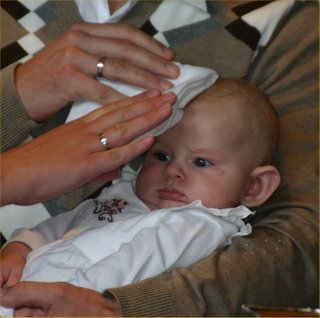
Yesterday I baptized the 3 month old daughter of a young couple in our church, who happen to be good friends of ours, whom I also married.

(Pulleeez..... no discussion on this blog from Reformed or Baptist Reformed or Baptist or Emerging or Pomos or Catholics or anyone else about whether child baptism is Biblical or not. My philosophy is: if I gave a New Testament to my nonbelieving neighbor and he wanted to obey it, he would sooner speak in tongues, prophesy and heal people than he would baptize children. I do it because it is my tradition and I think there are some good reasons to do it, but I hardly want to spend a minute 'defending' it.)

Anyway, just after I baptized her she flashed me one of those big smiles that only a 3 month old baby can give you. It was intentional, it was directed at me, and it broke my heart.

I thought of all I had missed and miss with my kids and my grandson because of distance.

And I thought of God's grace, totally unearned, being now poured out on this child and the world.
It was a moment that shook me to the core.

Neat that that can happen in a church service.

Thank you Famke!

Thursday, August 24, 2006

Pluto

Dear astronomers,

I’m not against democracy. I didn’t invent it – I actually think a benevolent dictatorship is the best – but it isn’t too bad.

Sometimes democracy - I will resist calling it dumbocracy – produces things to chuckle about. Italy, for example. Ross Perot. Florida 2000.

I still cannot for the life of me figure out how you think you can bring democracy to a country with the barrel of a gun. But that’s your business. I’ve given you permission to figure it out yourselves, and I’m pretty curious about how it’s going to work out. Maybe you finally will decide that a benevolent dictatorship is the best thing after all.

We did have to laugh when you decided (democratically?) that I was dead. “God ist tot!” screamed the madman in Nietzche’s The Gay Science in 1882. “And we have killed him!

He couldn’t convince his community of that, and so he cried “I’ve been born before my time!

But I did realize for the first time that you all thought you could determine whether I existed or not.

In 1966 it was official. “Is God dead?” asked Time Magazine on the cover.

"Ours is the first attempt in recorded history to build a culture upon the premise that God is dead" observed the Princeton theologian Paul Ramsey.

O.K. If you want to be that way. I can take it. Italy. Ross Perot. Florida 2000. My own existence.

But today you’ve taken on a favourite of mine. Pluto.

According to a democratic vote she is no longer a planet.

Now you’ve gone too far. I won’t stand for it.

You’ll get McCain. Or Hilary. I can't quite decide.

With lots of love,

God

P.S. Did you remember that you sent an explorer to Pluto in January of this year? It won’t get there until 2015!!

What a knee slapper that is!

Wednesday, August 23, 2006

Finally

Wow, this seems pretty clear.

But it's probably edited by the Left to make it sound this way......

Missionary

Last evening I had an experience that was a high point in my career as a missionary. On the surface it probably didn’t look like much, but the currents moving – in me at least – underneath the surface were powerful.

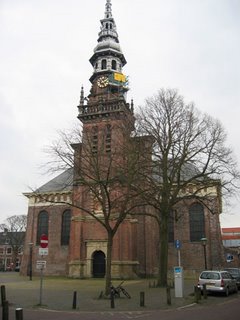
I did a wedding in the New Church in Haarlem.

You need to imagine to yourself: an old square in the old city of Haarlem, dating back to before the Middle Ages. A church built in 1649 (the tower dates back to 1613), modelled after the temple in Jerusalem (at least what people thought the temple looked like).


The organ was built in 1523, restored in 1985, and is known as one of the best pipe organs in Holland. Sounded magnificent.

Amazing to stand in that church before a group of people and conduct a wedding in a language and culture that is not your own.
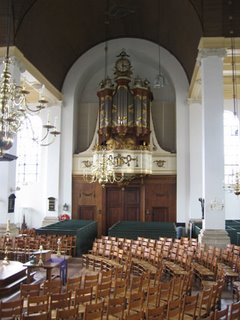
It is a goal of every missionary to be accepted by his or her “target group”. To be “one of them”. I think that has happened to Cyndi and I. I was asked by this couple to do the wedding, even though other minister colleagues of mine could have been asked just as easily. In attendance were people I have just recently met, but also people whom I have known for 15 years. Churched and unchurched people. Young and old. It was a community around a young couple, and we were part of the community.



Another goal of every missionary is to be a change agent - to see and say things just a little bit differently so that a culture acquires a new perspective and begins to change. It is a slow and ungainly process, but it can happen.

And I think it is happening. New ways of understanding who God is and what He has done and is doing, expressed in different images and words, are beginning to dawn. A new kind of community is being formed, one that desires to be a colony of God’s Kingdom here on earth. There is room for the highly educated professor and the mentally impaired. We are showing the world another kind of Christian.

It is not easy for the change agent – in this case, me (and my wife). I still feel the tension at the beginning of those kinds of services, when I realize that it will soon begin to dawn on a lot of people there that the guy standing in front is not a native Dutch speaker. Many of the customs still feel strange to me, and sometimes I think they are simply stupid. I would love sometime to be able to conduct such a service in my native language, with all the freedom of expression and wealth of resources that would give me.

But that’s what this business of missions is all about, and I am so grateful that God has helped my wife and me to hang in there all these years.

It is worth it.

Anne and Eva – congratulations!

Wednesday, August 16, 2006

Principles

One thing that struck me again when I was in the States this past week was that the Christian community very much wants to obey God’s principles.

That means, though, that you need to work to find out exactly what they are. What exactly is “stealing”? What are the Biblical grounds for divorce? Does the Bible allow certain types of discipline for children? What is gossip anyway? What can we do, and what must we avoid?

Once you have discovered what those principles are, then you have to hold to them. They are unbreakable. When you go against God’s principles you run the risk that the blessing will be taken away from or not poured out upon your life.

(I never hear anyone ask what God really and concretely would do if you broke one of the principles. Does He then throw you into Hell? Does He send misery and destruction your way? What exactly does He do? If you ask this question, you don’t get an answer. People cannot – in light of their theology – say that God throws them into Hell. Because they believe He is a loving Heavenly Father they cannot bring themselves to say that that He gives them a whopper of a disaster or a jolly good thump on the head (which, because God is doing it, bodes no good). But you still get the feeling that people believe that something will go irretrievably wrong if you transgress one of these Biblical principles. I remember once that I asked a colleague of mine, a minister, that question when he told me that he was afraid he was a very bad leader for his congregation. When I asked the question I saw his body literally relax. But he gave me no answer. I had to supply it.)

An elder in a congregation put it this way: If the path that we have chosen is wrong, we pray that God will give us the wisdom to see that. But in the meantime we must do what we see in His word, not what we don't see.

I experienced this as a strait jacket. Because people wanted to hold on to Biblical principles it seemed that every use of common sense was abandoned. There was no creativity anymore. People forgot that God has given us a set of brains to use. God-created gray matter.

A favourite author of mine wrote: Principles are what people have in place of God.

I believe I experienced that last week. And people get hurt by it.

Sad.

Tuesday, August 15, 2006

Fanny Pack: what women never think of

Last week I was with a (female) friend of mine when she - in a move that surprised me, because I didn't expect it of her - put on a "Fanny Pack".

For different styles of Fanny Packs, click here, or here, or here, or here.

Because we have a relationship based on perfect honesty, I shared with her two thoughts of mine about Fanny Packs. She had never thought of these things, and I share them with you because it may revolutionize the woman's relationship to Fanny Packs.

Here they are:

1. A Fanny Pack screams at the world "I am an American!!!" You are welcome to scream that if you like, and perhaps you deliberately want to scream that as you toddle around this dangerous world (an American is afraid of lots of things). But just so you know.

2. A Fanny Pack placed like this:

screams: "Look at my crotch!".

I really don't think most women want to send that message (again, I realize that there are women who do - feel free, go ahead, don't let me stop you), but you should know that it is pretty hard for any redblooded man not to go there.

For those of you who always wanted to know what is under those fanny packs, you can click here. But click here only if you really want to! You have been warned! (Why did you click?)

Anyway, I promised her I would do a service to all those unknowing women who walk around with Fanny Packs.

I keep my promises.

Now it's up to you. She will never wear one again.

Sunday, August 06, 2006

Philadelphia

I'm on my way tomorrow to Philadelphia for a week to be involved with some family issues that need attention.

I hadn't expected to go at this time, but I think it is good that I go.

I won't be blogging as much for the next week, but that's OK. Not many people read the blog anyway.

I may have a chance to let you know what's happening while I am there, otherwise I'll write something when I get back.

Friday, August 04, 2006

United 93

Yesterday my wife and I saw United 93 in Amsterdam.

I usually look at the site Rotten Tomatoes before I go to a film, and usually it is a very accurate judge of films for me. If it gives a rating below 60% I don't even bother to go.

United 93 is rated 90% - right on.

Great film. You feel the knot in your stomach already at the first scenes of a normal day on the East Coast. Normal people, getting on a normal flight. I can go a whole flight without saying anything to anybody - I usually prefer it that way, in fact (I never even used to feel guilty when I listened to evangelists who told about how they used the plane ride to evangelize seatmates).

The film just shows what happened on board that flight - at least what can be pieced together from telephone calls and other information. You learn nothing more about the passengers than what you would normally learn from passengers - until it is crisis time.

Of course you ask yourself the question whether you would have been part of the mutiny on board that plane. Of course I don't know - but would it be arrogant to say "I think so"?

I have felt these emotions before, but you want to just kill those hijackers.

It was a terrible and brutal day. It was totally wrong, with no justification. I hope no one takes my comments on this log about the War on Terror to mitigate the horror of that day at all.

At least the Japanese were honorable enough to attack military men.

I am worried about Muslim extremism, and I think we already have the 3rd World War on our hands. That's why I 'm so concerned that we fight it properly.

This film helps us understand.

Wednesday, August 02, 2006

I'm encouraged

Last night in Los Angeles, at the Los Angeles World Affairs Council, England’s Prime Minister Tony Blair gave a speech on the Middle East and the War on Terrorism that finally made some sense.

I don’t know what his motives were for this speech – I hope more than political gain – but the man said some things that I have missed in speeches from Washington or Downing Street ever since September 11, 2001.

A few quotes: (You can read the whole speech here)

There is an arc of extremism now stretching across the Middle East and touching, with increasing definition, countries far outside that region. To defeat it will need an alliance of moderation, that paints a different future in which Muslim, Jew and Christian; Arab and Western; wealthy and developing nations can make progress in peace and harmony with each other. My argument to you today is this: we will not win the battle against this global extremism unless we win it at the level of values as much as force, unless we show we are even-handed, fair and just in our application of those values to the world.
The point is this. This is war, but of a completely unconventional kind.

Unless we re-appraise our strategy, unless we revitalize the broader global agenda on poverty, climate change, trade, and in respect of the Middle East, bend every sinew of our will to making peace between Israel and Palestine, we will not win. And this is a battle we must win.
What is happening today out in the Middle East, in Afghanistan and beyond is an elemental struggle about the values that will shape our future.
It is in part a struggle between what I will call reactionary Islam and moderate, mainstream Islam. But its implications go far wider. We are fighting a war, but not just against terrorism but about how the world should govern itself in the early 21st century, about global values.

At other points in the speech he paints a one-sided and not entirely accurate picture of the arguments of people who are not in support of the intervention of the West in, specifically, Iraq. He defends the actions of America and Britain in Iraq and Afghanistan by saying we wanted “values change” not “regime change”. I’m not so sure that was the case. That was certainly not the grounds for going to war in those countries that was presented to us.

But anyway – he said two true things:

We will not win the battle against this global extremism unless we win it at the level of values as much as force, unless we show we are even-handed, fair and just in our application of those values to the world.

I have been saying that it seems that our only weapon is force, and we need other weapons too. Fairness and justice should be what people around the world think of when they think of us, not the barrel of a gun.

Unless we re-appraise our strategy, unless we revitalize the broader global agenda on poverty, climate change, trade, and in respect of the Middle East, bend every sinew of our will to making peace between Israel and Palestine, we will not win.

These are biblical issues - and they apply equally to everyone. Lately we have not been bending every senew of our will to make peace between Israel and Palestine, in fact, we have lately been encouraging the war.

Thanks Tony. I hope George Bush is listening.

As the British would say, “spot on”.