This in the news today about a resurgence of Al Qaeda.
Not really surprising.
Up until recently Buish has been saying that we are significantly crippling Al Qaeda. Apparently not.
It has already been announced that we are not winning in Iraq, probably soon he will have to announce we are not winning against Al Qaeda either.
I would use the word crazy to describe this if it weren't so dangerous.
Senior leaders of Al Qaeda operating from Pakistan have re-established significant control over their once-battered worldwide terror network and over the past year have set up a band of training camps in the tribal regions near the Afghan border, according to American intelligence and counterterrorism officials.
American officials said there was mounting evidence that Osama bin Laden and his deputy, Ayman al-Zawahri, had been steadily building an operations hub in the mountainous Pakistani tribal area of North Waziristan. Until recently, the Bush administration had described Mr. bin Laden and Mr. Zawahri as detached from their followers and cut off from operational control of Al Qaeda.
The new warnings are different from those made in recent months by intelligence officials and terrorism experts, who have spoken about the growing abilities of Taliban forces and Pakistani militants to launch attacks into Afghanistan. American officials say that the new intelligence is focused on Al Qaeda and points to the prospect that the terrorist network is gaining in strength despite more than five years of a sustained American-led campaign to weaken it.
The concern about a resurgent Al Qaeda has been the subject of intensive discussion at high levels of the Bush administration, the officials said, and has reignited debate about how to address Pakistan’s role as a haven for militants without undermining the government of Gen. Pervez Musharraf, the Pakistani president.
Last week, President Bush’s senior counterterrorism adviser, Frances Fragos Townsend, went to Afghanistan during a Middle East trip to meet with security officials about rising concerns on Al Qaeda’s resurgence in Afghanistan and Pakistan, an administration official said.
Officials from several different American intelligence and counterterrorism agencies presented a consistent picture in describing the developments as a major setback to American efforts against Al Qaeda.
Tuesday, February 20, 2007


Saturday, February 17, 2007
Thursday, February 15, 2007
Press Conference 2
Yesterday I said I'd quote some from Bushes' press conference of yesterday.
This post will be a little longer than normal, because I am quoting from the transcript.
The first subject has to do with the reliability of the intellingence telling us that Iran is sneding weapons to and meddling with the situation in Iraq.
It seems to me a most reasonable question and, in the light of the intelligence mistakes upon which the war in Iraq is based, absolutely necessary that we can trust the intelligence information we are getting. There is nothing political or negatively critical about the question. It is perfectly reasonable, and one we are most interested in.
That question was asked at least twice yesterday, and received no answer.
It is at least scandalous that no answer was given, and also alarming. Read it for yourself:
I also mentioned how difficult it is to understand Bush. If you have some time, try to figure out his answer to this question.
This post will be a little longer than normal, because I am quoting from the transcript.
The first subject has to do with the reliability of the intellingence telling us that Iran is sneding weapons to and meddling with the situation in Iraq.
It seems to me a most reasonable question and, in the light of the intelligence mistakes upon which the war in Iraq is based, absolutely necessary that we can trust the intelligence information we are getting. There is nothing political or negatively critical about the question. It is perfectly reasonable, and one we are most interested in.
That question was asked at least twice yesterday, and received no answer.
It is at least scandalous that no answer was given, and also alarming. Read it for yourself:
Q Thank you, sir. I'd like to follow on
THE PRESIDENT: I can say with certainty that the Quds force, a part of the Iranian government, has provided these sophisticated IEDs that have harmed our troops. And I'd like to repeat, I do not know whether or not the Quds force was ordered from the top echelons of government. But my point is what's worse -- them ordering it and it happening, or them not ordering it and it happening? And so we will continue to protect our troops.
David, our strategy is comprehensive in order to resolve problems that will affect our own peace and the peace in the world. And the biggest problem I see is the Iranians' desire to have a nuclear weapon. As you know, we've been dealing with this issue ever since you've been covering me, and pretty much ever since I've been the President. And we've made it very clear to the Iranians that if they would like to have a dialogue with the
But my focus is on making sure that this weapon is dealt with, the program is dealt with in a constructive, peaceful way. And we'll continue to work toward achieving our common objective with other nations in the world in a peaceful way.
THE PRESIDENT: Ed, we know they're there, we know they're provided by the Quds force. We know the Quds force is a part of the Iranian government. I don't think we know who picked up the phone and said to the Quds force, go do this, but we know it's a vital part of the Iranian government. What matters is, is that we're responding. The idea that somehow we're manufacturing the idea that the Iranians are providing IEDs is preposterous, Ed. My job is to protect our troops. And when we find devices that are in that country that are hurting our troops, we're going to do something about it, pure and simple.
I also mentioned how difficult it is to understand Bush. If you have some time, try to figure out his answer to this question.
Q Mr. President, do you agree with the National Intelligence Estimate that we are now in a civil war in
…The reason I described that is that no matter what you call it, it's a complex situation, and it needed to be dealt with inside of
Now only 704 days.
Wednesday, February 14, 2007
Press Conference
I'm listening live to the Bush press conference today.
He really does simply avoid answering some pretty straightforward questions.
Some of what he says is really absolute nonsense.
Some of it is not understandable.
The English continues to be butchered.
It's an embarrassment.
When the text is printed, I'll comment more specifically.
Only 705 days, my counter tells me.
He really does simply avoid answering some pretty straightforward questions.
Some of what he says is really absolute nonsense.
Some of it is not understandable.
The English continues to be butchered.
It's an embarrassment.
When the text is printed, I'll comment more specifically.
Only 705 days, my counter tells me.
Children and the Kingdom
Today UNICEF published a report entitled: An overview of child well-being in rich countries.
It is an assessment of the wellbeing of children and adolescents in econcomically advanced nations.
On the front page are these words:
It is interesting that Holland takes the first prize, having the highest average ranking.
The United Kingdom and the United States find themselves in the bottom third of the rankings for five of the six dimensions reviewed - Britain last and the U.S. next to last.
The U.S. has the higest number of children in households with less than 50% of the median income, and ranks, in that category, last.
My sermon this coming Sunday will be on Jesus' parable about Kingdom as a mustard seed that provides a nesting place for the birds of the air. Where the Kingdom is, people - and children - are safe.
Should give us a lot to think about. Where is Gods Kingdom now really?
Why are children so safe in "secular" Holland, and so unsafe in "Christian" America?
And what are you doing to promote the wellbeing of the next generation?

It is an assessment of the wellbeing of children and adolescents in econcomically advanced nations.
On the front page are these words:
The true measure of a nation’s standing is how well it attends to its children – their health and safety, their material security, their education and socialization, and their sense of being loved, valued, and included in the families and societies into which they are born.
It is interesting that Holland takes the first prize, having the highest average ranking.
The United Kingdom and the United States find themselves in the bottom third of the rankings for five of the six dimensions reviewed - Britain last and the U.S. next to last.
The U.S. has the higest number of children in households with less than 50% of the median income, and ranks, in that category, last.
My sermon this coming Sunday will be on Jesus' parable about Kingdom as a mustard seed that provides a nesting place for the birds of the air. Where the Kingdom is, people - and children - are safe.
Should give us a lot to think about. Where is Gods Kingdom now really?
Why are children so safe in "secular" Holland, and so unsafe in "Christian" America?
And what are you doing to promote the wellbeing of the next generation?

Tuesday, February 13, 2007
Derailed
Yesterday I had a conversation with someone about what it is like when things get difficult - either temporarily or for the long haul.
I used the example of a train that is derailed. It's not going anywhere (for a while).
 What you don't need is someone who makes all kinds of suggestions about what you could/should have done to prevent the derailment.
It also doesn't help if those around you say or think look, you derailed the train, get it back on the tracks yourself, and when things are running again I'll catch up with you.
You need someone who bends down to help you without saying too much.
 Sometimes you need more than one person.

I used the example of a train that is derailed. It's not going anywhere (for a while).
 What you don't need is someone who makes all kinds of suggestions about what you could/should have done to prevent the derailment.
It also doesn't help if those around you say or think look, you derailed the train, get it back on the tracks yourself, and when things are running again I'll catch up with you.
You need someone who bends down to help you without saying too much.
 Sometimes you need more than one person.
Saturday, February 10, 2007
Deadly Sins
This list of the deadly sins of preaching as given by John Ortberg and reproduced on Out of Ur. Good stuff, and so relevant.
1. The temptation to be inauthentic
We want to present an image to others that makes us appear more holy, intelligent, or godly than we actually are. In the end this is a foolish pursuit because the truth of who we are will always leak out.
2. The temptation to live for recognition
After finishing a sermon the question that runs through most of our minds is, did they like it? But we need to learn to root our identity in something other than applause. Ortberg cited Dallas Willard’s ability to present his material and give no thought to people’s reactions. He’s like a child who releases a helium balloon. He says what God’s given him to say, and simply lets it go.
3. The temptation to live in fear
What if I fail? That question plagues many pastors. But there is a difference between failing at something and being a failure. You are not a failure. Again, our identity must been hidden in Christ and not our accomplishments.
4. The temptation to compare
With the radio, television, and the internet our generation faces this temptation more than any previous generation. Our culture of celebrity pastors causes us to compare ourselves to others. This does nothing good for the soul.
5. The temptation to exaggerate
This seems closely linked to temptation number one. Overstating facts is how we often try to manage our image and appear better than we are. John also linked this to plagiarism—passing someone else’s story, sermon, or idea off as our own to win approval.
6. The temptation to feel chronically inadequate
7. The temptation of pride
Having people listen to you give a monologue every week can make you prideful. The antidote? A wife. (Ortberg’s joke, not mine.)
8. The temptation to manipulate
Having a pulpit and speaking the words of God might give some a power rush. We mustn’t use our position to manipulate people into doing what we want them to do.
9. The temptation of envy
This seems related to number four, the temptation to compare. But envy carries the nuance of desire and ambition. We not only compare ourselves to another preacher, but we seek to achieve what they have. Such selfish motivations will undermine our spiritual health.
10. The temptation of anger
John read this quote from Henri Nouwen that says it all:
Anger in particular seems close to a professional vice in the contemporary ministry. Pastors are angry at their leaders for not leading and at their followers for not following. They are angry at those who do not come to church for not coming and angry at those who do come for coming without enthusiasm. They are angry at their families, who make them feel guilty, and angry at themselves for not being who they want to be. This is not an open, blatant, roaring anger, but an anger hidden behind the smooth word, the smiling face, and the polite handshake. It is a frozen anger, an anger which settles into a biting resentment and slowly paralyzes a generous heart. If there is anything that makes the ministry look grim and dull, it is this dark, insidious anger in the servants of Christ.
1. The temptation to be inauthentic
We want to present an image to others that makes us appear more holy, intelligent, or godly than we actually are. In the end this is a foolish pursuit because the truth of who we are will always leak out.
2. The temptation to live for recognition
After finishing a sermon the question that runs through most of our minds is, did they like it? But we need to learn to root our identity in something other than applause. Ortberg cited Dallas Willard’s ability to present his material and give no thought to people’s reactions. He’s like a child who releases a helium balloon. He says what God’s given him to say, and simply lets it go.
3. The temptation to live in fear
What if I fail? That question plagues many pastors. But there is a difference between failing at something and being a failure. You are not a failure. Again, our identity must been hidden in Christ and not our accomplishments.
4. The temptation to compare
With the radio, television, and the internet our generation faces this temptation more than any previous generation. Our culture of celebrity pastors causes us to compare ourselves to others. This does nothing good for the soul.
5. The temptation to exaggerate
This seems closely linked to temptation number one. Overstating facts is how we often try to manage our image and appear better than we are. John also linked this to plagiarism—passing someone else’s story, sermon, or idea off as our own to win approval.
6. The temptation to feel chronically inadequate
7. The temptation of pride
Having people listen to you give a monologue every week can make you prideful. The antidote? A wife. (Ortberg’s joke, not mine.)
8. The temptation to manipulate
Having a pulpit and speaking the words of God might give some a power rush. We mustn’t use our position to manipulate people into doing what we want them to do.
9. The temptation of envy
This seems related to number four, the temptation to compare. But envy carries the nuance of desire and ambition. We not only compare ourselves to another preacher, but we seek to achieve what they have. Such selfish motivations will undermine our spiritual health.
10. The temptation of anger
John read this quote from Henri Nouwen that says it all:
Anger in particular seems close to a professional vice in the contemporary ministry. Pastors are angry at their leaders for not leading and at their followers for not following. They are angry at those who do not come to church for not coming and angry at those who do come for coming without enthusiasm. They are angry at their families, who make them feel guilty, and angry at themselves for not being who they want to be. This is not an open, blatant, roaring anger, but an anger hidden behind the smooth word, the smiling face, and the polite handshake. It is a frozen anger, an anger which settles into a biting resentment and slowly paralyzes a generous heart. If there is anything that makes the ministry look grim and dull, it is this dark, insidious anger in the servants of Christ.
Wednesday, February 07, 2007
Contrast
If you have some time, check out these two videos.
One is emerging church.
A little, like, too much, like, vague, for me, like, what are these guys like really saying?
The second is selling someone a product based on fear - fear of hell. Can you imagine how succesful a counselor would be using this approach to save a marriage on the rocks?
(I did like the girl who wouldn't admit that "cursing" was such a sin. She stood up to them.)
Been there, done that.
Won't do it again.
One is emerging church.
A little, like, too much, like, vague, for me, like, what are these guys like really saying?
The second is selling someone a product based on fear - fear of hell. Can you imagine how succesful a counselor would be using this approach to save a marriage on the rocks?
(I did like the girl who wouldn't admit that "cursing" was such a sin. She stood up to them.)
Been there, done that.
Won't do it again.
Death by Ministry
From Mark Driscoll, the following information about pastors in America.
When have you last prayed for your pastor and his wife?
When have you last encouraged your pastor and his wife?
Pastors
• Fifteen hundred pastors leave the ministry each month due to moral failure, spiritual burnout, or contention in their churches.
• Fifty percent of pastors' marriages will end in divorce.
• Eighty percent of pastors and eighty-four percent of their spouses feel unqualified and discouraged in their role as pastors.
• Fifty percent of pastors are so discouraged that they would leave the ministry if they could, but have no other way of making a living.
• Eighty percent of seminary and Bible school graduates who enter the ministry will leave the ministry within the first five years.
• Seventy percent of pastors constantly fight depression.
• Almost forty percent polled said they have had an extra-marital affair since beginning their ministry.
• Seventy percent said the only time they spend studying the Word is when they are preparing their sermons.
Pastors' Wives
• Eighty percent of pastors' spouses feel their spouse is overworked.
• Eighty percent of pastors' spouses wish their spouse would choose another profession.
• The majority of pastor's wives surveyed said that the most destructive event that has occurred in their marriage and family was the day they entered the ministry.
When have you last prayed for your pastor and his wife?
When have you last encouraged your pastor and his wife?
Pastors
• Fifteen hundred pastors leave the ministry each month due to moral failure, spiritual burnout, or contention in their churches.
• Fifty percent of pastors' marriages will end in divorce.
• Eighty percent of pastors and eighty-four percent of their spouses feel unqualified and discouraged in their role as pastors.
• Fifty percent of pastors are so discouraged that they would leave the ministry if they could, but have no other way of making a living.
• Eighty percent of seminary and Bible school graduates who enter the ministry will leave the ministry within the first five years.
• Seventy percent of pastors constantly fight depression.
• Almost forty percent polled said they have had an extra-marital affair since beginning their ministry.
• Seventy percent said the only time they spend studying the Word is when they are preparing their sermons.
Pastors' Wives
• Eighty percent of pastors' spouses feel their spouse is overworked.
• Eighty percent of pastors' spouses wish their spouse would choose another profession.
• The majority of pastor's wives surveyed said that the most destructive event that has occurred in their marriage and family was the day they entered the ministry.
Friday, February 02, 2007
Tuesday, January 30, 2007
One bullet
This story in the New York Times of Monday, January 29.
You can do nothing else than have enormous respect for the soldiers who exhibit such bravery in such dangerous and overwhelming circumstances. I hope and pray with all my heart that God (and anyone else who can) protects them from harm.
Staff Sgt. Hector Leija scanned the kitchen, searching for illegal weapons. One wall away, in an apartment next door, a scared Shiite family huddled around a space heater, cradling an infant.
I have already said on this weblog, but I will say it again: guerilla warfare can almost never be won. Our soldiers are being put into a no-win situation, and the addition of 21,000 troops does nothing to give hope that the situation will improve in the long term.
If I was in the States I would join a peace rally. For a half-decent comparison of Iraq with Viet Nam, click here.

You can do nothing else than have enormous respect for the soldiers who exhibit such bravery in such dangerous and overwhelming circumstances. I hope and pray with all my heart that God (and anyone else who can) protects them from harm.
Staff Sgt. Hector Leija scanned the kitchen, searching for illegal weapons. One wall away, in an apartment next door, a scared Shiite family huddled around a space heater, cradling an infant.
It was after 9 a.m. on Wednesday, on Haifa Street in central Baghdad, and the crack-crack of machine-gun fire had been rattling since dawn. More than a thousand American and Iraqi troops had come to this warren of high rises and hovels to disrupt the growing nest of Sunni and Shiite fighters battling for control of the area.
The joint military effort has been billed as the first step toward an Iraqi takeover of security. But this morning, in the two dark, third-floor apartments on Haifa Street, that promise seemed distant. What was close, and painfully real, was the cost of an escalating street fight that had trapped American soldiers and Iraqi bystanders between warring sects.
I have already said on this weblog, but I will say it again: guerilla warfare can almost never be won. Our soldiers are being put into a no-win situation, and the addition of 21,000 troops does nothing to give hope that the situation will improve in the long term.
If I was in the States I would join a peace rally. For a half-decent comparison of Iraq with Viet Nam, click here.

Monday, January 29, 2007
God weeps
"God weeps," Archbishop Tutu told participants in the ecumenical gathering near the conclusion of the World Social Forum in Nairobi, "and says, 'Who will help me so we can have a different kind of world, one in which the rich know they have been given much so they can share and help others?'"
More than 50,000 community activists, social reformers, religious leaders, and movers and shakers met at the seventh World Social Forum in Nairobi, Kenya, this January to compare strategies on transforming global economic systems to benefit the majority world, rather than maintaining economic systems that produce immoral disparities: one percent of the world's adults owns 40 percent of the world's wealth, while the bottom half combined owns less than one percent.
This from God's Politics, the weblog of Jim Wallis.
What can you do, as an unbelievably rich person, to contribute to righting the imbalances in the world?
More than 50,000 community activists, social reformers, religious leaders, and movers and shakers met at the seventh World Social Forum in Nairobi, Kenya, this January to compare strategies on transforming global economic systems to benefit the majority world, rather than maintaining economic systems that produce immoral disparities: one percent of the world's adults owns 40 percent of the world's wealth, while the bottom half combined owns less than one percent.
This from God's Politics, the weblog of Jim Wallis.
What can you do, as an unbelievably rich person, to contribute to righting the imbalances in the world?
Friday, January 26, 2007
Words
The New York Times has an interesting interactive site that helps you see what words George Bush used in his State of the Union speeches, how many times he used them, in which speech, and the context of the words.
He has spoken over 34,000 words in these addresses, and you can search for words and find out exactly when and how he used them.
For example, "Iraq" was used 34 times in 2007, "Social Security" twice. In 2005, the year of his big (failed) Social Security push, he used the word 8 times.
Interesting that he clearly says, in 2007, that we are failing at protecting Social Security.
About Iraq he says: Let us find our resolve, and turn events to victory.
He also says that our commitment to Iraq is not open ended. (I thought we couldn't say that, that would be capitulating to the enemy.)
And we learn that Iraq's government has committed itself to a series of benchmarks. During the election campaign, benchmarks were of the devil.
Throughout history, Presidents have begun their State of the Union with the ringing words "The State of our Union is strong".
This year he couldn't bring himself to begin this way. So he slipped it in the last sentence: We've met challenges and faced dangers, and we know that more lie ahead. Yet we can go forward with confidence -- because the State of our Union is strong, our cause in the world is right, and tonight that cause goes on.
Check out the site, it is a lot of fun.
He has spoken over 34,000 words in these addresses, and you can search for words and find out exactly when and how he used them.
For example, "Iraq" was used 34 times in 2007, "Social Security" twice. In 2005, the year of his big (failed) Social Security push, he used the word 8 times.
Interesting that he clearly says, in 2007, that we are failing at protecting Social Security.
About Iraq he says: Let us find our resolve, and turn events to victory.
He also says that our commitment to Iraq is not open ended. (I thought we couldn't say that, that would be capitulating to the enemy.)
And we learn that Iraq's government has committed itself to a series of benchmarks. During the election campaign, benchmarks were of the devil.
Throughout history, Presidents have begun their State of the Union with the ringing words "The State of our Union is strong".
This year he couldn't bring himself to begin this way. So he slipped it in the last sentence: We've met challenges and faced dangers, and we know that more lie ahead. Yet we can go forward with confidence -- because the State of our Union is strong, our cause in the world is right, and tonight that cause goes on.
Check out the site, it is a lot of fun.
Monday, January 22, 2007

Wednesday, January 17, 2007
Tuesday, January 16, 2007
Diplomacy
This is what we need more of, and it is encouraging.
Public American diplomacy in the Middle East: high level (Condoleeza Rice) and public. The Isreali-Palestinian conflict lies at the heart of much of the problem in the Middle East. Anything that will help solve that problem will help reduce terrorism.
Good.
Good.
It appears that Rice also wants to try to sell Bushes' plan for Iraq. I hope she listens well.
A good car salesman listens to his customer.

Public American diplomacy in the Middle East: high level (Condoleeza Rice) and public. The Isreali-Palestinian conflict lies at the heart of much of the problem in the Middle East. Anything that will help solve that problem will help reduce terrorism.
Good.
Good.
It appears that Rice also wants to try to sell Bushes' plan for Iraq. I hope she listens well.
A good car salesman listens to his customer.

Sunday, January 14, 2007
The latest funnies
"The good news is last night President Bush finally admitted he's made mistakes in Iraq. The bad news is he's planning to make the same mistakes again." --Jay Leno
"After hearing the president's speech, Democrats in the Senate are seeking bipartisan support for a non-binding resolution opposing President Bush's deployment of his military escalation. In response, President Bush said, 'Huh?'" --Conan O'Brien
"President Bush is now calling for sending 21,000 more troops to Iraq. How does he come up with that number? I don't even think 21,000 people in the country think it's a good idea." --Jay Leno
"President Bush announced he's creating 20,000 new jobs. They're all in Iraq." --Jay Leno
"Yesterday Al Sharpton was asked about running for president, and he said, 'I'm not hearing a lot of meat. When the meats hit the fire, we'll find out if there's some real meat there.' Personally, I think it's a shame President Bush can't run again, because that would be one hell of a debate." --Conan O'Brien
"After hearing the president's speech, Democrats in the Senate are seeking bipartisan support for a non-binding resolution opposing President Bush's deployment of his military escalation. In response, President Bush said, 'Huh?'" --Conan O'Brien
"President Bush is now calling for sending 21,000 more troops to Iraq. How does he come up with that number? I don't even think 21,000 people in the country think it's a good idea." --Jay Leno
"President Bush announced he's creating 20,000 new jobs. They're all in Iraq." --Jay Leno
"Yesterday Al Sharpton was asked about running for president, and he said, 'I'm not hearing a lot of meat. When the meats hit the fire, we'll find out if there's some real meat there.' Personally, I think it's a shame President Bush can't run again, because that would be one hell of a debate." --Conan O'Brien
Guts
News report today:
A British newspaper reported Sunday that Prince Harry (who is third in line to the British throne) was scheduled to begin final training for deployment to Iraq with his Army regiment -- but the defense ministry said no decision had been made on whether his regiment would be deployed.
John McCain's son may also go to Iraq, now that the President needs more troops.
There were, of course, many stories going around about G.W.'s stint in the military. Who knows what the truth really is, but the very fact that these stories are out there (and no stories of this nature would even be taken seriously if they were about John McCain, his son, or Prince Harry) says something about our Commander in Chief.
A British newspaper reported Sunday that Prince Harry (who is third in line to the British throne) was scheduled to begin final training for deployment to Iraq with his Army regiment -- but the defense ministry said no decision had been made on whether his regiment would be deployed.
John McCain's son may also go to Iraq, now that the President needs more troops.
There were, of course, many stories going around about G.W.'s stint in the military. Who knows what the truth really is, but the very fact that these stories are out there (and no stories of this nature would even be taken seriously if they were about John McCain, his son, or Prince Harry) says something about our Commander in Chief.
Thursday, January 11, 2007
Failure according to Bush
You have certainly seen or heard this, but if not, here it is.
And it isn't even a late-night joke!
Apparently Bushspeak and Rumsspeak is contagious.
An interview by CNN with Frances Townsend, Homeland Security Advisor:
And it isn't even a late-night joke!
Apparently Bushspeak and Rumsspeak is contagious.
An interview by CNN with Frances Townsend, Homeland Security Advisor:
HENRY: You know, going back to September 2001, the president said, dead or alive, we're going to get him. Still don't have him. I know you are saying there's successes on the war on terror, and there have been. That's a failure.TOWNSEND: Well, I'm not sure -- it's a success that hasn't occurred yet. I don't know that I view that as a failure.
They don't have to come
 A first reaction to the speech of President Bush.
He said this: The consequences of failure are clear: (..) Our enemies would have a safe haven from which to plan and launch attacks on the American people. On September the 11th, 2001, we saw what a refuge for extremists on the other side of the world could bring to the streets of our own cities.
116 Americans died in December 2006 in Iraq. The total number of deaths to this point is 3019.
If the violence continues at this same pace (and most - including Bush himself - expect it to get worse) another 1000 Americans will lose their lives in 2007.
On September 11 2001 we lost 2996 Americans.
The terrorists don't have to come to the streets of our cities anymore.
They can kill us right in the streets of Baghdad.
Tuesday, January 09, 2007

Another facet
An article by Ryan Beiler on another aspect of Saddam and Iraq. Click here for the weblog.
One salient point that I've found missing from most commentary on the execution is that the specific crime of which Hussein was convicted - the 1982 massacre of 148 Iraqis in the town of Dujail - occurred while Hussein was being aided by the United States.
The infamous photo of Donald Rumsfeld shaking hands with Hussein was taken in 1983. What's more, the U.S. actively supported Hussein throughout the '80s in spite of reports of such atrocities, including the use of chemical weapons. This isn't conspiracy theory - the report linked above is drawn almost entirely from mainstream media sources like The New York Times, Los Angeles Times, and The Washington Post. Of course, this isn't news to anyone who's followed Iraq-U.S. politics for any length of time. The joke about how "the
It just seems especially ironic that so many Americans are celebrating the death of a tyrant who was executed for a crime committed while he was "our S.O.B." Iraqis had long suffered because of U.S. support for Saddam, and now American servicemen and women have joined them in paying dearly for the war to remove him.
Wednesday, January 03, 2007
Biting my fingernails
Apparently George Bush is going to unveil his plan for
I have just minimal knowledge of how other cultures work, and the culture of the
1. Don’t ever make a martyr out of someone. Every culture has its martyrs, who are heroes. The worst thing you can do if you are trying to stamp out a resistance movement is create martyrs for it. That means, I would think, that one would wait with Saddam’s execution until the situation has stabilized in
2. A war should always be for just causes and bring justice (at least from our Western perspective). By not making Saddam stand trial for all the crimes of which he was charged you create a deep sense of injustice in many victims. I believe you could heal things in
3. Avoid looking like an occupying army. The
4. The hardest war to fight and win is a guerrilla war. We should have learned that in
5. You cannot impose, from outside, a political system or a religion on a people. Democracy, for example. You have to win hearts and change the culture from inside. The barrel of a gun will never do it.
But I still hope.
Tuesday, January 02, 2007
Attitude toward enemies
A quote from Dietrich Bonhoeffer.
Don't forget that he voluntarily returned to Germany from a safe position in New York because he felt he could not minister to his people after the Nazi regime was gone if he didn't suffer with his people under the regime.
And we was finally hanged by the Nazis in prison in 1945, just three weeks before the liberation. He has the right to speak about the Christian attitude towards enemies:
[N]ever be conceited. With respect to our attitude toward our enemies, this means first, remember that you were God's enemy and that, without having earned it or being worthy of it, you were met with mercy. It means second, remember that God hung on the cross for your enemy too, and love God and God loves you.
- Dietrich Bonhoeffer
Don't forget that he voluntarily returned to Germany from a safe position in New York because he felt he could not minister to his people after the Nazi regime was gone if he didn't suffer with his people under the regime.
And we was finally hanged by the Nazis in prison in 1945, just three weeks before the liberation. He has the right to speak about the Christian attitude towards enemies:
[N]ever be conceited. With respect to our attitude toward our enemies, this means first, remember that you were God's enemy and that, without having earned it or being worthy of it, you were met with mercy. It means second, remember that God hung on the cross for your enemy too, and love God and God loves you.
- Dietrich Bonhoeffer
Monday, January 01, 2007
The secrets died with him
Robert Fisk is a controversial figure. Some say he is in bed with the Arab countries of the Middle East and so his reporting and criticism of the West can't be trusted. I don't really know. It is obvious that he has spent much time in the Middle East and gets to places (partly because he is a very brave man) that other reporters don't. It certainly is worth listening to his voice.
This article (one of a couple) on the death of Saddam from which I reproduce a few excerpts:
This article (one of a couple) on the death of Saddam from which I reproduce a few excerpts:
We've shut him up. The moment Saddam's hooded executioner pulled the lever of the trapdoor in
At the time, the Iranians claimed that this terrible cocktail had been given to Saddam by the
We still don't know - and with Saddam's execution we will probably never know - the extent of US credits to
The whole truth died with Saddam Hussein in the
Happy New Year
In 2007 a new look for this blog, which is not read by too many people. The last count showed an average of 6 persons per day.
That's alright - it gives me a chance to express myself, particularly on politics, Iraq, etc. If you want to read a really good blog that will make you think and laugh, try Jon Swift.
Anyway - a Happy New Year to all 6 of you!
I hope you have a healthy, happy, fruitful and blessed 2007!
That's alright - it gives me a chance to express myself, particularly on politics, Iraq, etc. If you want to read a really good blog that will make you think and laugh, try Jon Swift.
Anyway - a Happy New Year to all 6 of you!
I hope you have a healthy, happy, fruitful and blessed 2007!
Sunday, December 31, 2006
Sleeping again.
According to news reports, President Bush was sleeping when Saddam Hussein was executed.
Let's see:
6 AM in Iraq is 4 AM in Amstderdam
4 AM in Amsterdam is 10 PM in Washington.
Bush was not in Washington, but in Texas.
10 PM in Washington is 9 PM in Texas.
And Bush is sleeping.
A week or so ago there was a column in the paper here about the leaders of the "good old days" who slept very little. Churchill was reported to sleep as little as possible, but he always took a nap during the day. Especially during World War II Churchill could bring himself to get to bed early at all.
And now we are in a 'war aginst terrorism', in which our freedom hangs in the balance.
And our leader is already sleeping at 9PM.
Let's see:
6 AM in Iraq is 4 AM in Amstderdam
4 AM in Amsterdam is 10 PM in Washington.
Bush was not in Washington, but in Texas.
10 PM in Washington is 9 PM in Texas.
And Bush is sleeping.
A week or so ago there was a column in the paper here about the leaders of the "good old days" who slept very little. Churchill was reported to sleep as little as possible, but he always took a nap during the day. Especially during World War II Churchill could bring himself to get to bed early at all.
And now we are in a 'war aginst terrorism', in which our freedom hangs in the balance.
And our leader is already sleeping at 9PM.
Monday, December 25, 2006
The Innkeeper
by Frederick Buechner
“That was a long, long time ago,” said the Innkeeper, “and a long, long way away. But the memories of men are also long, and nobody has forgotten anything about my own sad, queer part in it all unless maybe they have forgotten the truth about it. But you can never blame people for forgetting the truth because it is, after all, such a subtle and evasive commodity. In fact, all that distinguishes a truth from a lie may finally be no more than just the flutter of an eyelid or the tone of a voice. If I were to say, ‘I BELIEVE!’ that would be a lie, but if I were to say, ‘I believe…’ that might be the truth. So I do not blame posterity for forgetting the subtleties and making me out to be the black villain of the piece – the heartless one who said, ‘No room! No room!’ I’ll even grant you that a kind of villainy may be part of the truth. But if you want to speak the whole truth, then you will have to call me a villain with a catch in your voice, at least a tremor, a hesitation maybe, with even the glitter of almost a tear in your eye. Because nothing is entirely black, you know. Not even the human heart.
“I speak to you as mean of the world,” said the Innkeeper. “Not as idealists but as realists. Do you know what it is like to run an inn – to run a business, a family, to run anything in this world for that matter, even your own life? It is like being lost in a forest of a million trees,” said the Innkeeper, “and each tree is a thing to be done. Is there fresh linen on all the beds? Did the children put on their coats before they went out? Has the letter been written, the book read? Is there money enough left in the bank? Today we have food in our bellies and clothes on our backs, but what can we do to make sure that we will have them still tomorrow? A million trees. A million things.
“Until finally we have eyes for nothing else, and whatever we see turns into a thing. The sparrow lying in the dust at your feet – just a thing to be kicked out of the way, not the mystery of death. The calling of children outside your window – just a distraction, an irrelevance, not life, not the wildest miracle of them all. That whispering in the air that comes sudden and soft from nowhere – only the wind, the wind…
“Of course I remember very well the evening they arrived. I was working on my accounts and looked up just in time to see the woman coming through the door. She walked in that slow, heavy-footed way that women have in their last months, as though they are walking in a dream or at the bottom of the sea. Her husband stood a little behind her – a tongue-tied, helpless kind of man, I though. I cannot remember either of them saying anything, although I suppose some words must have passed. But at least it was mostly silence. The clumsy silence of the poor. You know what I mean. It was clear enough what they wanted.
“The stars had come out. I remember the stars perfectly though I don’t know why I should, sitting inside as I was. And my wife’s cat jumped up onto the table where I was sitting. I had not stood up, of course. There was mainly just silence. Then it happened much in the way you have heard. I did not lie about there being no room left – there really was none – though perhaps if there had been a room, I might have lied. As much for their sakes as for the sake of the inn. Their kind would have felt more at home in a stable, that’s all, and I do not mean that unkindly either. God knows.
“Later that night, when the baby came, I was not there,” the Innkeeper said. “I was lost in the forest somewhere, the unenchanted forest of a million trees. Fifteen steps to the cellar, and watch out for your head going down. Firewood to the left. If the fire goes out, the heart freezes. Only the wind, the wind. I speak to you as men of the world. So when the baby came, I was not around, and I saw none of it. As for what I heard – just at that moment itself of birth when nobody turns into somebody – I do not rightly know what I heard.
“But this I do know. My own true love. All your life long, you wait for your own true love to come – we all of us do – our destiny, our joy, our heart’s desire. So how am I to say it, gentlemen? When he came, I missed him.
“Pray for me, brothers and sisters. Pray for the Innkeeper. Pray for me, and for us all, my own true love."
Friday, December 22, 2006
Mideast rules to live by
It would really be good if our government had some understanding of how things work in the Middle East. I know from my experience working in other cultrues how important it is to understand how the other person thinks, without passing judgement as to whether that is the correct way to think or not. The worlde is made up of different cultures, and we need to learn to work within that framework. We don´t have any choice. This article by Thomas Friedman is good along those lines.
For a long time, I let my hopes for a decent outcome in
Rule 1: What people tell you in private in the
Rule 2: Any reporter or U.S. Army officer wanting to serve in
Rule 3: If you can’t explain something to Middle Easterners with a conspiracy theory, then don’t try to explain it at all — they won’t believe it.
Rule 4: In the
Rule 5: Never lead your story out of
Rule 6: In the
Rule 7: The most oft-used expression by moderate Arab pols is: “We were just about to stand up to the bad guys when you stupid Americans did that stupid thing. Had you stupid Americans not done that stupid thing, we would have stood up, but now it’s too late. It’s all your fault for being so stupid.”
Rule 8: Civil wars in the Arab world are rarely about ideas — like liberalism vs. communism. They are about which tribe gets to rule. So, yes,
Rule 9: In
Rule 10: Mideast civil wars end in one of three ways: a) like the
Rule 11: The most underestimated emotion in Arab politics is humiliation. The Israeli-Arab conflict, for instance, is not just about borders.
Rule 12: Thus, the Israelis will always win, and the Palestinians will always make sure they never enjoy it. Everything else is just commentary.
Rule 13: Our first priority is democracy, but the Arabs’ first priority is “justice.” The oft-warring Arab tribes are all wounded souls, who really have been hurt by colonial powers, by Jewish settlements on Palestinian land, by Arab kings and dictators, and, most of all, by each other in endless tribal wars. For
Rule 14: The Lebanese historian Kamal Salibi had it right: “Great powers should never get involved in the politics of small tribes.”
Rule 15: Whether it is Arab-Israeli peace or democracy in
Monday, December 18, 2006
"This week a top general at the Pentagon said the War on Terror could take a 100 years to fight. President Bush was furious about the 100-year prediction and said, 'Stop setting a fixed timetable'" --Conan O'Brien
"They had the Iraqi Commission report and President Bush says he will not make a decision about getting us out of Iraq until 2007. He says he wants to give it some careful thought ... unlike getting us into Iraq." --David Letterman
"Did you know former President Garfield could write Latin with one hand and Greek with the other at the same time? That was Garfield. When President Bush heard about it, he said, 'We had a talking cat for president?'" --Jay Leno
"They had the Iraqi Commission report and President Bush says he will not make a decision about getting us out of Iraq until 2007. He says he wants to give it some careful thought ... unlike getting us into Iraq." --David Letterman
"Did you know former President Garfield could write Latin with one hand and Greek with the other at the same time? That was Garfield. When President Bush heard about it, he said, 'We had a talking cat for president?'" --Jay Leno
Friday, December 15, 2006
Monday, December 11, 2006
Changing with every wind
Here you have it again.
"Like most Americans, this administration wants to succeed in Iraq," the president said yesterday after 90 minutes of discussions and a briefing from Baghdad.
Before the elections, "most" Americans were accused of not wanting to win but wanting to lose, especially if they openly raised questions about the progress in Iraq.
If you figure that the Democrats won the election with a small majority, and they were the ones questioning Bushes' policies, and thus were accused of being unpatriotic and wanting to lose, this is quite a change of perspective.
Makes one long for the good old days of John Kerry.
"Like most Americans, this administration wants to succeed in Iraq," the president said yesterday after 90 minutes of discussions and a briefing from Baghdad.
Before the elections, "most" Americans were accused of not wanting to win but wanting to lose, especially if they openly raised questions about the progress in Iraq.
If you figure that the Democrats won the election with a small majority, and they were the ones questioning Bushes' policies, and thus were accused of being unpatriotic and wanting to lose, this is quite a change of perspective.
Makes one long for the good old days of John Kerry.
Friday, December 08, 2006
Clinton in Holland

Yesterday Bill Clinton gave a speech in de Soestdijk Palace in Holland, the former home of Prince Bernhard and Queen Juliana.
His William J. Clinton Foundation is working together with the Dutch Postcode Lottery to fight AIDS, poverty and promote environmental responsibilty.
I know I had said I would put a short hold on bashing Bush while waiting for his response to the midterm elections, the TSG and other input into the Iraq war and situation. But the contrast between the speaking skills of these two men is so enormous I can't let it pass by.
I listened to the speech via the website of the Postcode Lottery. A few remarks:
Clinton has the innate ability to get a crowd eating out of the palm of his hand. I realize you can say it is fake, a put-on, that he is a charlatan. I don't think so. I do public speaking for a living, and I know what it takes to get a crowd sitting on the edge of it's chair. You don't do that day in and day out if you are a fake.
He is extremely articulate, makes very few grammatical mistakes, and knows exactly what words to give to what he wants to say. And it has been known for a long time that his mastery of facts and figures is superb.
Specific facts and stories are placed in the context of larger themes and developments. The listener knows, at the end of a speech, how to think and how to act. It is a real learning experience to listen to him.
After the speech was over, Clinton received a light bulb that is being developed in the Netherlands. It produces a certain amount of light using 75% less energy.
Clinton's off the cuff remark was (and he had just come back from a long trip to Asia): "When I saw a Buddhist monk meditating in Asia, I thought to myself that I also could use a little bit of enlightenment. I didn't know I would be getting it this soon."
The master.
Thursday, December 07, 2006
You say it, then I won't have to
Watched the press conference with Blair and Bush today (live).
I was interested to see how Bush would act and what he would say after yesterday’s ISG report came out.
One thing stands out in the report – it is a plea for unity in the American government and people:
What we recommend in this report demands a tremendous amount of political will and
cooperation by the executive and legislative branches of the
skilful implementation. It demands unity of effort by government agencies. And its success
depends on the unity of the American people in a time of political polarization. Americans can
and must enjoy the right of robust debate within a democracy. Yet
doomed to failure—as is any course of action in
sustained consensus. The aim of our report is to move our country toward such a consensus.
I actually agree with Rush Limbaugh (3 times divorced, caught coming across the border recently with Viagra – what does he need that for with no wife? – and admitted drug addict) that the plea for consensus and bipartisanship seems to be the primary goal of the drafters of the report. I don’t agree with Limbaugh's usual rant and rave that it is because they want
I was planning to give Bush a lot of slack and be easier on him than I have been in the hope that he would really start to change his language and perhaps even his thinking. The jury is still out on that, but today’s press conference was not encouraging.
I actually got the idea that he gladly lets the ISG and, today, Tony Blair, say the hard things that need to be said so he doesn’t have to say them. It seems that that was also the mission of Robert Gates yesterday in front of the Senate.
“You guys say the hard stuff, that gives me the chance to just agree with you without having to say it myself.”
He did today repeat his contention that we are in an ideological struggle. My question still remains: it seems obvious that you don’t fight an ideological struggle only with military means. What other means are we using to fight – and win – that struggle? I don’t sense any understanding of those issues on his part.
I still will give Bush a chance. I hope he gets on track, I really do.
But I do continue to be embarrassed by his (mis)use of the English language. And, honestly, sometimes it looked as if Tony Blair (an Englishman who takes great pride in the English language) was really suffering watching George speak.
A few direct quotes:
A report chaired by James Baker…..
We will support the democrat government of Mailiki…
I talk to families who die…
We must remove obstacles necessary to achieve the vision….
Lord, help us….(again - or keep doing it - or something)
Sunday, December 03, 2006
Rumsfeld's memo
With the elections of November 2006 - and thus the need to politicize so much of its rhetoric - over, it is becoming more and more clear what a mess the Bush administration has made of the Iraq situation, and how much of the election rhetoric has been disingenuous and political in nature.Iraq
And now this has been made startlingly clear in the leaked Rumsfeld memo. I have read the memo and it is absolutely shocking, when you consider that it was written one day before the elections.
With Bush insisting “we are winning and we will win”, Rumsfeld was writing: clearly, what
The Democrats were being accused of “cut and run”, and of therefore not wanting us to win in
While Saddam Hussein was being sentenced to death, Rumsfeld proposed the following: provide money to key political and religious leaders (as Saddam Hussein did), to get them to help us get through this difficult period.
The cynicism of these statements is breathtaking in the light of almost 3000
Recast the
It would, of course, be doubly cynical if the White House was using this memo and other "leaks" occuring now to prepare the ground for a change of rhetoric and stance. I remember when Bush declared that leaks would not be tolerated in his administration. Now he's not saying anything.
I saw John Kerry live on CNN’s Late Edition with Wolf Blitzer. He was very articulate and knowledgeable. He could speak easily of the different factions vying for power in
You certainly never hear George Bush speaking with any kind of sophistication about these complex and extremely important matters. ("One has a stronger hand when there's more people playing your same cards.")
Wednesday, November 29, 2006
The War
I read in National Geographic two articles about the medical care of wounded soldiers and Iraqis. Pretty shocking stuff, as all war is, of course.
Also a powerful article by Bob Herbert of the New York Times. Some excerpts:
Estonia
After months of accusing the Democrats of having no plan, it is obvious Bush doesn´t have one either. And now of course news reports are appearing that one of the President´s top advisors doesn´t believe the Iraqi Prime Minister has the ability to stem the violence in his country. (Lest you think it is just liberal, biased media reporting this, World Magazine is reporting it also).
I am starting to realize I use this blog to vent about the war. But I don´t know where else to go with my frustration. And when Tony Snow says something dumb like "I think the general notion is a civil war is when you have people who, to use the American Civil War or other civil wars as an example, where people break up into clearly identifiable feuding sides clashing for supremacy within Iran…”, thereby making in this otherwise unintelligble sentence a geographic mistake (must be learning it from his President) and, as Jon Swift comments, “referring by mistake to the upcoming war in Iran instead of Iraq”, I don't know what to do anymore.
Look at this picture, pray for our brave soldiers and pray to God that our government somehow starts thinking with clarity, common sense and bravery.

Also a powerful article by Bob Herbert of the New York Times. Some excerpts:
Americans are shopping while
There is something terribly wrong with this juxtaposition of gleeful Americans with fistfuls of dollars storming the department store barricades and the slaughter by the thousands of innocent Iraqi civilians, including old people, children and babies. The war was started by the
The war has now lasted as long as the American involvement in World War II. But there is no sense of collective sacrifice in this war, no shared burden of responsibility. The soldiers in
They are dying anonymously and pointlessly, while the rest of us are free to buckle ourselves into the family vehicle and head off to the malls and shop.
After months of accusing the Democrats of having no plan, it is obvious Bush doesn´t have one either. And now of course news reports are appearing that one of the President´s top advisors doesn´t believe the Iraqi Prime Minister has the ability to stem the violence in his country. (Lest you think it is just liberal, biased media reporting this, World Magazine is reporting it also).
I am starting to realize I use this blog to vent about the war. But I don´t know where else to go with my frustration. And when Tony Snow says something dumb like "I think the general notion is a civil war is when you have people who, to use the American Civil War or other civil wars as an example, where people break up into clearly identifiable feuding sides clashing for supremacy within Iran…”, thereby making in this otherwise unintelligble sentence a geographic mistake (must be learning it from his President) and, as Jon Swift comments, “referring by mistake to the upcoming war in Iran instead of Iraq”, I don't know what to do anymore.
Look at this picture, pray for our brave soldiers and pray to God that our government somehow starts thinking with clarity, common sense and bravery.

Tuesday, November 28, 2006
Freedom from what?
In response to my last blog, someone asked the question: free from what?
It would require a long answer to fully explain it, but I’ll try to make a couple of comments. If you have further questions feel free to ask.
I would guess the main freedom is this: I grew up with the idea that the Gospel was primarily about going to heaven when I/we die. The focus was on making sure that I had the right/enough faith so that I could answer the famous Kennedy question: are you sure God would let you into His heaven if you were to die tonight?
This has also been a primary theme of my almost 30 years as missionary, evangelist and pastor. Can the other person also answer this question with confidence?
Underlying the concern for this question is of course the issue of hell. If someone cannot answer this question (and its companion question: on what basis should God let you into His heaven?) then I need to be concerned that he or she will spend eternity in hell.
This perspective led to several kinds of stresses: concern for the “lost” world and the pressure to take every opportunity to “lead someone to Christ”. No contact, friendship or relationship was without that underlying “pressure”. No sacrifice, even of family relationships, was too small for that one “eternal soul”. The “Day of Christ’s Appearing” was, in theory, a day of great joy, but in reality a day of judgement for myself (had I correctly believed?) and for those of whose “salvation” I was not “sure” whatever that meant, and that question was a source of many fiery theological discussions. Not to mention the “depression” of living in a world that was doomed to destruction, even though we did our best to obey the command to make the most of this world.
For the last 20+ years I have been wondering if that (eternal destiny) is the central issue of the Bible/New Testament. I have come to believe it is not. I’m not saying those issues are not discussed, they are just not the central ones.
N.T. Wright has helped tremendously in putting all these questions in a good Biblical context, one that takes the Bible and the work of Christ seriously. He asks (and provides (his) answers to) questions about what Jesus and the early church meant when they said certain things. It is a scholarly approach to the Scriptures that takes belief seriously, instead of the critical approach which undermines so much.
The perspective of the Kingdom as Wright outlines it really does “free” one from the stresses I mentioned above while providing a real positive way in which to be involved in today’s world.
The words of Jesus “as the Father has sent me, so send I you”, have taken on a much newer and deeper meaning for me, and I am able to put this into practice (with all my failures) with conviction and joy.
To understand more of Wright’s thought, see him Home Page, linked in that blog. I don’t have time or space here to summarize everything. Try his stuff on the resurrection first. The Resurrection as a Historical Problem, for example.
Monday, November 27, 2006
N.T. Wright, New Perspective, Emerging
The last few days I've heard a few lectures and discussions with N.T. Wright, read a few blogs about Emerging and that kind of stuff.
It is not all equally clear or helpful, but these movements, especially Wright, are putting some perspectives on the gospel and the church in the world that are just magnificent and so helpful and freeing.
If you don't know N.T. Wright, read some stuff from his Home Page.
I would say that this stuff doesn't really repudiate anything I learned growing up or what I got out of college and seminary. It does say that some things should be understood differently, but it is not negative in saying it is worthless or harmful.
It rather adds perspective and provides a way to ask the "critical" questions about the Bible without denying its authority or the centrality and necessity of Christ and His work.
I am much more able to put my whole heart, mind and life into the work of the church than I was before.
It is really too bad that so many Christians (and Christian bloggers) are so negative and unwilling to learn from these men. I understand why that is, but it is really too bad.
Don't be afraid to ask the hard questions. God will not "get you" if you do.
But keep Christ and His Word central.
It is not all equally clear or helpful, but these movements, especially Wright, are putting some perspectives on the gospel and the church in the world that are just magnificent and so helpful and freeing.
If you don't know N.T. Wright, read some stuff from his Home Page.
I would say that this stuff doesn't really repudiate anything I learned growing up or what I got out of college and seminary. It does say that some things should be understood differently, but it is not negative in saying it is worthless or harmful.
It rather adds perspective and provides a way to ask the "critical" questions about the Bible without denying its authority or the centrality and necessity of Christ and His work.
I am much more able to put my whole heart, mind and life into the work of the church than I was before.
It is really too bad that so many Christians (and Christian bloggers) are so negative and unwilling to learn from these men. I understand why that is, but it is really too bad.
Don't be afraid to ask the hard questions. God will not "get you" if you do.
But keep Christ and His Word central.
powered by performancing firefox
Saturday, November 25, 2006
Thursday, November 23, 2006
Dutch Elections Update
In the first place, more than 80% of the Dutch population voted. Compared to the USA a very high number. One reason for that is that people really feel they can vote for someone who represents their views.
Let me try to explain what happened.
The Christian Democratic Appeal has been the ruling party for the last 4 years. This party has its roots in Christian movements at the end of the 19th century. In order to form a majority, and thus a government, the CDA formed a coalition with the VVD and D66. Bascially conservative, moderate right wing, if you take everything together. Because the D66 pulled out of the Cabinet last spring new elections were needed.
The Labor Party was the great rival of the CDA and had hoped to win this election. Their leader would then become Prime Minister. Last spring it looked like they would win in a landslide.
The problem in Dutch politics is that there are really no "hot issues" at this moment. The immigration issues are pretty much resolved, the economy is getting better, government finances and the welfare system have been reformed. More work needs to be done, but essentially things are going along OK.
Interestingly enough, the Iraq War was not an issue in these elections. And the environment did not get much attention either.
So what happened? The CDA lost some seats but is still the biggest party and will probably provide the Prime Minister (Balkenende again). The VVD and D66 lost big time. They are totally out of the picture.
The Labour Party lost also. They do not have enough seats to come close to forming a coalition government.
The winners?
The SP, the Socialist Party, went from nine to twentysix seats. These were the old communists. They took many voters from the Labor Party. Primarily because of the trustworthiness of the leader of the SP. People trusted him more than the young leader of the Labor Party, Wouter Bos.
Two big surprises:
The Party for Freedom won nine seats. This party is very right wing, extremely so.
And the Party for Animals won two seats. A party that wants to protect the rights of animals. For example, this party wants to ban the castration of pigs without anaesthesia.
So the Dutch politcal landscape is splintered. That will make forming a government difficult.
The Christian Union, a conservative evangelical Christian party, had 3 seats in Parliament, now has 6 seats.
There is a chance that this party is big enough that it could form, with other parties, a majority in Parliament and thus help form the government.
Imagine: in liberal, apostate Holland, villified because of its policies on drugs, sex, euthanasia and homosexuality, an evangelical conservative Christian party may play a major role in the government.
I wonder what World Magazine will say about that, if anything.
Let me try to explain what happened.
The Christian Democratic Appeal has been the ruling party for the last 4 years. This party has its roots in Christian movements at the end of the 19th century. In order to form a majority, and thus a government, the CDA formed a coalition with the VVD and D66. Bascially conservative, moderate right wing, if you take everything together. Because the D66 pulled out of the Cabinet last spring new elections were needed.
The Labor Party was the great rival of the CDA and had hoped to win this election. Their leader would then become Prime Minister. Last spring it looked like they would win in a landslide.
The problem in Dutch politics is that there are really no "hot issues" at this moment. The immigration issues are pretty much resolved, the economy is getting better, government finances and the welfare system have been reformed. More work needs to be done, but essentially things are going along OK.
Interestingly enough, the Iraq War was not an issue in these elections. And the environment did not get much attention either.
So what happened? The CDA lost some seats but is still the biggest party and will probably provide the Prime Minister (Balkenende again). The VVD and D66 lost big time. They are totally out of the picture.
The Labour Party lost also. They do not have enough seats to come close to forming a coalition government.
The winners?
The SP, the Socialist Party, went from nine to twentysix seats. These were the old communists. They took many voters from the Labor Party. Primarily because of the trustworthiness of the leader of the SP. People trusted him more than the young leader of the Labor Party, Wouter Bos.
Two big surprises:
The Party for Freedom won nine seats. This party is very right wing, extremely so.
And the Party for Animals won two seats. A party that wants to protect the rights of animals. For example, this party wants to ban the castration of pigs without anaesthesia.
So the Dutch politcal landscape is splintered. That will make forming a government difficult.
The Christian Union, a conservative evangelical Christian party, had 3 seats in Parliament, now has 6 seats.
There is a chance that this party is big enough that it could form, with other parties, a majority in Parliament and thus help form the government.
Imagine: in liberal, apostate Holland, villified because of its policies on drugs, sex, euthanasia and homosexuality, an evangelical conservative Christian party may play a major role in the government.
I wonder what World Magazine will say about that, if anything.
Wednesday, November 22, 2006
Dutch Elections
Today the Dutch vote for a new Parliament and Cabinet.
I must say I really like the parliamentary system. Actually, the Dutch system is offically called Proportional Representation. See Wikipedia for the differences.
There are quite a variety of political parties, so you have a good chance that you can get people in the parliament who reflect your own views, even if that is only one person.
It also forces parties to work together. If no party gets a majority of seats in the Parliament (and that almost never happens), then parties need to work together to form a majority and construct the Cabinet.
Even for Christians in Holland there are a couple of good choices to make, in which you can think about moral, economic, political and environmental issues.
I will never forget that a relative once asked me, "Well Norm, what's it like living in a communist country?"
Holland gets a lot of bad press in the U.S.A. of the Religious Right. Most of it, like this question, rooted in ignorance and fear.
Don't get me wrong - there are a number of things about Holland that drive me absolutely crazy.
But the windmills, tulips and wooden shoes are really cute.

I must say I really like the parliamentary system. Actually, the Dutch system is offically called Proportional Representation. See Wikipedia for the differences.
There are quite a variety of political parties, so you have a good chance that you can get people in the parliament who reflect your own views, even if that is only one person.
It also forces parties to work together. If no party gets a majority of seats in the Parliament (and that almost never happens), then parties need to work together to form a majority and construct the Cabinet.
Even for Christians in Holland there are a couple of good choices to make, in which you can think about moral, economic, political and environmental issues.
I will never forget that a relative once asked me, "Well Norm, what's it like living in a communist country?"
Holland gets a lot of bad press in the U.S.A. of the Religious Right. Most of it, like this question, rooted in ignorance and fear.
Don't get me wrong - there are a number of things about Holland that drive me absolutely crazy.
But the windmills, tulips and wooden shoes are really cute.

Tuesday, November 21, 2006
Friday, November 17, 2006
Unpopular anywhere
"Political experts say President Bush planned a trip to several foreign countries this week because he is unpopular at home. In response, the White House said, That's ridiculous. The president is just as unpopular overseas."
--Conan O'Brien
--Conan O'Brien
Tuesday, November 14, 2006
Bush Sr.
Seems George W. Jr. has been to the woodpile with his father.
George Sr. thinks George Jr. is making a mess of things.
He wants to make sure his son doesn't get a bad name in the history books.
He has told his son to go to his room and be quiet.
He has sent two of his old helpers to the White House to straighten things out.
James B aker, Secretary of State for president George H.W. Bush, now heads the Iraq Stu
 dy Group and paid a visit to the White House yesterday.
Robert Gates, Director of the CIA for president George H.W. Bush, will take over for Rumsfeld at the Department of Defense.
Not a bad deal.
Something profitable gets done in the Middle East.
George Jr. gets the credit.
I don't really care if George Jr. gets the credit or not, as long as this disaster he has gotten us into gets turned around.
George Sr. thinks George Jr. is making a mess of things.
He wants to make sure his son doesn't get a bad name in the history books.
He has told his son to go to his room and be quiet.
He has sent two of his old helpers to the White House to straighten things out.
James B
 aker, Secretary of State for president George H.W. Bush, now heads the Iraq Stu
 dy Group and paid a visit to the White House yesterday.
Robert Gates, Director of the CIA for president George H.W. Bush, will take over for Rumsfeld at the Department of Defense.
Not a bad deal.
Something profitable gets done in the Middle East.
George Jr. gets the credit.
I don't really care if George Jr. gets the credit or not, as long as this disaster he has gotten us into gets turned around.
Friday, November 10, 2006
God's tears
I ran across this quote from someone on a blog this morning.
I thought it was good food for thought for today.
Without Jesus, God doesn't have tears.
I thought it was good food for thought for today.
Without Jesus, God doesn't have tears.

Thursday, November 09, 2006
Rumsfeld 2

In brief remarks yesterday, Rumsfeld described the Iraq conflict as a "little understood, unfamiliar war" that is "complex for people to comprehend."
So we are dumb? Is that the problem?
Check these quotes out from our former Defense Secretary:
"I would not say that the future is necessarily less predictable than the past. I think the past was not predictable when it started."
"I am not going to give you a number for it because it's not my business to do intelligent work."
"I don't know what I said, but I know what I think, and, well, I assume it's what I said."
"There's another way to phrase that and that is that the absence of evidence is not the evidence of absence. It is basically saying the same thing in a different way. Simply because you do not have evidence that something does exist does not mean that you have evidence that it doesn't exist."
"If I know the answer I'll tell you the answer, and if I don't, I'll just respond, cleverly."
C.S. Lewis once said, "you don't make nonsense sense by putting 'God can' in front of it".
You don't make nonsense sense by having Rumsfeld say it and then calling us dumb when we don't understand it.
Good riddance.
Wednesday, November 08, 2006
Rumsfeld
Maybe Bush is starting to get the idea.
I haven't seen his news conference yet, but I hope he is starting to realize that "stay the course" isn't always the most productive course to stay on.
A good step is that Rumsfeld is gone. The arrogance of that man was always appalling to me, as was his inability to really understand how the world works. (Or maybe he does understand how the world really works, but that would be so appalling to many of us if we heard it that he makes sure we can't find out.)
It's pretty hard to forget Rumsfeld's handshake with Saddam Hussein in 1983.
 I hope the Bush administration will work with the new Congress and Senate to bring some sanity back to this "War on Terror".
I will be terrified if he doesn't.
I haven't seen his news conference yet, but I hope he is starting to realize that "stay the course" isn't always the most productive course to stay on.
A good step is that Rumsfeld is gone. The arrogance of that man was always appalling to me, as was his inability to really understand how the world works. (Or maybe he does understand how the world really works, but that would be so appalling to many of us if we heard it that he makes sure we can't find out.)
It's pretty hard to forget Rumsfeld's handshake with Saddam Hussein in 1983.
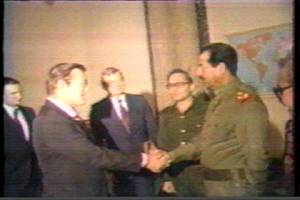 I hope the Bush administration will work with the new Congress and Senate to bring some sanity back to this "War on Terror".
I will be terrified if he doesn't.
Friday, November 03, 2006
Back to Abu Ghraib


Thursday, November 02, 2006
Overindulgence
Fortune Magazine reports:
Sales of big pickup trucks and SUVs went through the roof - doubling from the year before in some cases. Sales of small, fuel efficient cars, meanwhile, remained stagnant. It is as if all that moaning and groaning about price gouging by oil companies never happened....
As Americans flock back to their old buying habits, it is all too easy (for sociologists) to lump excessive fuel consumption in with other bad habits involving overindulgence: over eating, over spending and over television watching....
The supply of oil is not limitless but apparently the current generation of Americans is all too willing to exhaust it by buying more vehicle than they need and letting their children and grandchildren fend for themselves.
So many conservative Christian bloggers are all up in arms about the Emerging Church or the New Perspective on Paul, wildly promoting Spurgeon, Owen, Augustine and Calvin in order to restore doctrinal purity to the church and America.
You never hear them on these kinds of issues.
Sales of big pickup trucks and SUVs went through the roof - doubling from the year before in some cases. Sales of small, fuel efficient cars, meanwhile, remained stagnant. It is as if all that moaning and groaning about price gouging by oil companies never happened....
As Americans flock back to their old buying habits, it is all too easy (for sociologists) to lump excessive fuel consumption in with other bad habits involving overindulgence: over eating, over spending and over television watching....
The supply of oil is not limitless but apparently the current generation of Americans is all too willing to exhaust it by buying more vehicle than they need and letting their children and grandchildren fend for themselves.
So many conservative Christian bloggers are all up in arms about the Emerging Church or the New Perspective on Paul, wildly promoting Spurgeon, Owen, Augustine and Calvin in order to restore doctrinal purity to the church and America.
You never hear them on these kinds of issues.
Subscribe to:
Posts (Atom)

